
★★★★★ 67 five-star Google reviews · Indianapolis HQ | Same-week appointments · 4 metros | (317) 210-0098 · Find your closest office
Sewer Scope
Defect dictionary

What does a bad sewer scope look like? Seven defects.

A sewer scope finds seven categories of defect, and each one has a different repair cost, a different urgency, and a different look on camera. The dictionary below shows what every defect actually is, why it fails, what it looks like on the camera feed, and what the repair will cost. Sourced.

8min read
2026·05·26Last revised
14Citations
Defect taxonomyThe 7 things the camera finds
The dictionary

Seven things the camera actually finds.

Each card below covers what the defect is, why it fails, what it looks like on the camera feed, and what the repair will run. Repair cost ranges are sourced. Indianapolis-specific cost numbers live in our Indy defect prevalence guide.
OB

Orangeburg pipe

1945 to 1972 · highest priority
+
What it is
Bituminized fiber pipe made from wood pulp sealed with liquefied coal tar pitch. Manufactured from the 1860s through the 1970s, most commonly installed 1945 to 1972 in U.S. residential laterals.
Why it fails
Useful life is about 50 years under ideal conditions. Known failures inside 10 years; deformation common after 30 years. Soft material deforms under soil pressure into oval cross-sections, then collapses.
On camera
Rough, corrugated texture. Dark brown to black. Often visibly deformed, oval-shaped, or partially collapsed. Distinct from cast iron's smooth rust-streaked wall and PVC's smooth white surface.
Repair
Full lateral replacement is typical. Trenchless options if access allows. National range an amount that varies by plumber. Indianapolis-specific ranges in our Indy prevalence guide.
Source: Wikipedia · InspectAPedia · Structure Tech
CI

Cast iron scale

Mid-life, 25+ year mark
+
What it is
Rust plus mineral and waste residue built up inside the pipe wall. Develops in cast iron sewer mains as the metal oxidizes from the inside out.
Why it fails
Lifespan is 50 to 100 years. Deterioration begins after 25 years. Scale narrows the pipe diameter, slowing drainage and trapping debris. Soil acidity accelerates the process.
On camera
Jagged, rust-colored buildup on the pipe walls. Heavy scale narrows the visible diameter. Worst-case shows channeling (the bottom of the pipe has rusted through completely, exposing soil).
Repair
Light to moderate: hydro-jetting $300 to $700. Heavy: mechanical chain descaling an amount that varies by plumber (can restore diameter and extend life by decades). Channeled cast iron requires replacement.
Source: Balkan Plumbing · Northwest Sewer descaling
RT

Root intrusion

50%+ of all blockages
+
What it is
Tree roots that have found a joint, hairline crack, or weakness in the lateral and grown inside the pipe seeking moisture and nutrients.
Why it fails
Roots cause more than 50% of all sewer blockages. Aggressive species: willow, poplar, maple, oak, elm. Clay tile and Orangeburg are most vulnerable; PVC less so but joints still leak.
On camera
White, hair-like or rope-like masses growing into the line from a joint. Heavy intrusion shows as a thick curtain of root material partially or fully blocking flow.
Repair
Single intrusion: hydro-jetting plus mechanical root cutting $300 to $700. Recurring: trenchless lining an amount that varies by plumber (creates a smooth interior root cannot re-enter).
Source: ARS Rescue Rooter · Zoom Drain species reference
BL

Belly / sag

Soil settlement defect
+
What it is
A low spot in the lateral where the pipe has sagged below grade and waste pools at the low point instead of flowing through.
Why it fails
Soil settling, poor compaction at install, seasonal saturation, freeze-thaw cycles. Pooled waste builds blockages over time and creates the breeding ground for harder clogs.
On camera
Standing water visible at the low point, often with sediment and debris collecting. The camera shows the pipe sloping downward then back up.
Repair
Spot repair an amount that varies by plumber. Full replacement of the bellied section runs an amount that varies by plumber. Trenchless lining sometimes works for shallow bellies; pronounced sags require excavation.
Source: A.S. Plumbing belly cost · Mother Plumbing
OS

Offset joint

Settlement + root pressure
+
What it is
Pipe sections pushed out of alignment so they no longer meet flush. The joint between two sections has shifted laterally.
Why it fails
Ground movement, settling, root pressure pushing pipe sections sideways. Offset joints catch debris, slow flow, and frequently leak at the misaligned junction.
On camera
A visible step or shelf where one pipe section ends and the next begins out of line. Sometimes accompanied by root intrusion at the offset point.
Repair
Trenchless lining an amount that varies by plumber (CIPP or pipe bursting depending on offset severity). Traditional excavation $50 to $250 per foot, with typical project totals of $3,000 to $7,000.
Source: Express Sewer · Nuflow offset trenchless
CR

Cracks + fractures

Longitudinal + transverse
+
What it is
Cracks in the pipe wall, either running along the length (longitudinal, from pressure above) or across (transverse, from settling).
Why it fails
Pressure from above (driveways, vehicle loads, freeze-thaw) creates longitudinal cracks. Settling creates transverse cracks. Both let groundwater in and waste out.
On camera
Visible cracks in the pipe wall, sometimes with soil intrusion or staining where groundwater enters. Hairline cracks may not need immediate action and should be re-scoped in 3 to 5 years.
Repair
CIPP trenchless lining an amount that varies by plumber (creates a structural sleeve inside the existing pipe). Spot excavation cost varies widely with depth and surface restoration.
Source: LWTech Welding crack types · Harts Services crack reference
TP

City-tap separation

Connection failure at the main
+
What it is
The connection where the homeowner's lateral joins the city sewer main has separated, allowing soil and groundwater intrusion at the connection point.
Why it fails
Original installation that has settled differently than the surrounding soil. Root intrusion at the junction. Vibration from street traffic in front of the property.
On camera
A visible gap or step at the city-tap connection. Often accompanied by visible soil at the connection point or active water infiltration.
Repair
an amount that varies by plumber typical, higher if the connection sits under the street. Requires utility coordination because the work happens at the boundary between homeowner ownership and municipal ownership.
Source: Express Sewer tap separation reference
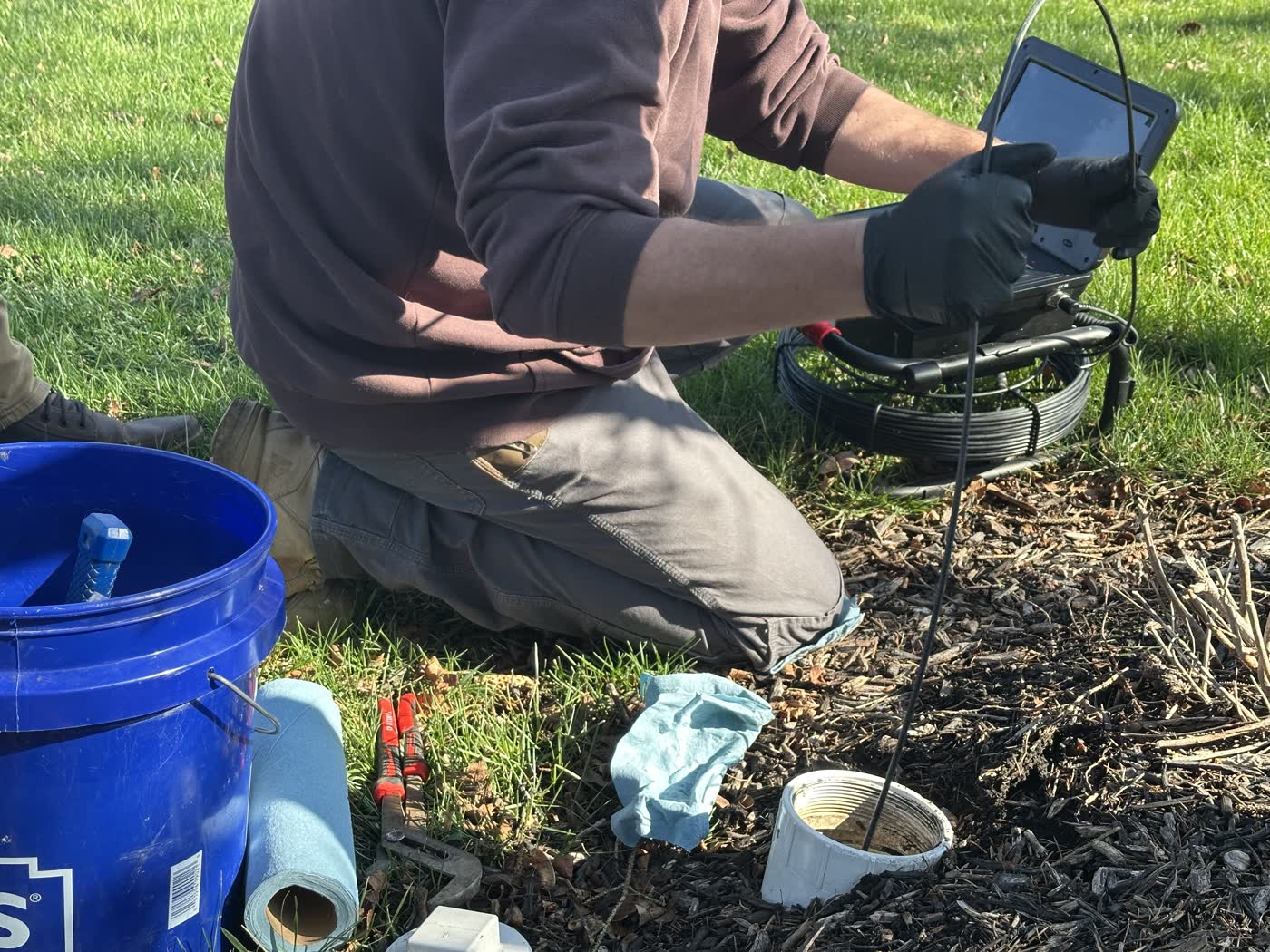
Inspector reviewing the live sewer camera monitor during a yard inspection.
How to read the report

Three sections matter most.

Every reputable sewer scope deliverable includes a video file plus a written report. The report has three sections every buyer should learn to read:

1. The page-1 summary. One paragraph that translates the technical findings into deal-language. "Lateral material is cast iron from house to street with moderate scale at 22 ft and 38 ft. Recommend descaling. No structural defects identified." This is the line the buyer's agent reads first.

2. The video capture. Photos pulled from the video at each finding, with depth and distance marked. Stills let a plumber writing a repair quote know exactly where to look. If the report has no video capture, the report is incomplete.

3. The footage link. A shareable video file (typically MP4) the buyer's plumber watches before bidding the fix. Plumbers who bid blind off a report alone tend to overbid. Plumbers who watch the footage bid closer to reality.

The defect taxonomy above is the language a good report uses. If the report says "found pipe deterioration at 31 ft" without specifying Orangeburg vs. cast iron scale vs. crack, the report is undersourced. A specialist report names the defect.

When findings change the deal

Three remedies, depending on the defect.

The buyer's option period exists for exactly this purpose. A scope finding triggers one of three negotiation paths:

Remedy 1: Seller repairs before closing. Cleanest for the buyer. The seller's plumber bids the fix, the work happens before the final walkthrough, and the buyer closes on a known-good lateral. Common for major defects (Orangeburg, severe offset, city-tap separation) where the lender or buyer would not accept the property as-is.

Remedy 2: Buyer accepts a closing credit. Seller drops the price by the estimated repair amount and the buyer handles the work post-closing. Common for moderate defects (cast iron scale, single root intrusion, hairline cracks) where the buyer wants to control vendor selection and timing.

Remedy 3: Buyer accepts the property as-is. Buyer knew about the defect, factored it into the price, and proceeds. Common for minor findings (light scale, a single hairline crack flagged for re-scoping in 5 years) that do not justify renegotiation.

The remedy is a function of the defect, the lender's policy, and the buyer's tolerance for post-closing work. The sewer scope report does not pick the remedy; it just hands the buyer's agent the data needed to negotiate.

Real Google questions, real answers

Defect-specific FAQ. Sourced.

The questions buyers ask Google about specific sewer-scope findings.

What does Orangeburg pipe look like on a sewer scope?

On camera, Orangeburg appears rough, corrugated, and dark brown to black. It is often visibly deformed, oval-shaped, or partially collapsed because the bituminized fiber softens under soil pressure. Most Orangeburg in service today is well past its 50-year useful life. If your scope shows Orangeburg, plan on full lateral replacement.

Source: Structure Tech · InspectAPedia
Does Orangeburg pipe contain asbestos?

No. Orangeburg pipe is made of wood pulp sealed with liquefied coal tar pitch. It does not contain asbestos. The structural failure mode is soft-material deformation under soil pressure, not fiber release.

Source: Wikipedia
How long do cast iron sewer pipes last?

Cast iron sewer mains last 50 to 100 years with deterioration beginning after about 25 years. Soil acidity accelerates corrosion. Most cast iron mains installed before 1980 are now mid-life and almost certainly scaled. Descaling restores diameter and can extend useful life decades.

Source: Balkan Plumbing · Parker and Sons
How serious is root intrusion in a sewer line?

Root intrusion is the single most common cause of sewer blockages, responsible for more than 50% of all blockages. A single root intrusion can be cleared with hydro-jetting and mechanical root cutting for $300 to $700. Recurring intrusions need trenchless lining for an amount that varies by plumber.

Source: ARS Rescue Rooter
What causes a sewer belly?

Bellies are caused by soil settling, poor compaction at install, seasonal saturation, or freeze-thaw cycles. The pipe sags below grade and waste pools at the low point. Indianapolis-area clay soils plus freeze-thaw make bellies common in older lateral installs.

Source: A.S. Plumbing
Should I worry about a hairline crack on the scope report?

Not immediately. A hairline crack with no visible water intrusion and no associated defect typically does not require emergency repair. Plan to re-scope the line in 3 to 5 years. If the crack widens or shows water infiltration on the next scope, CIPP trenchless lining is the standard remedy.

Source: Harts Services
Related guides

Keep reading.

Indianapolis-specific defect prevalence and local repair cost data? Indy defect prevalence guide →

Book a Scope