
Marion County's housing-era distribution drives the defect mix every Indianapolis sewer scope finds. Orangeburg pipe concentrates in 46220 and 46226 pre-1972 builds. Cast iron is everywhere pre-1980. Silver maple root intrusion is endemic to Indy bungalow lots. The Indy-specific prevalence pattern, with real repair cost ranges, below.
Orangeburg pipe was installed in U.S. residential laterals most commonly between 1945 and 1972 (per Wikipedia's Orangeburg reference). Indianapolis's housing distribution puts the heaviest Orangeburg concentration in the ZIPs that built out during that window. Broad Ripple and Meridian-Kessler (46220) boomed in the 1920s to 1930s and saw heavy lateral replacement during the Orangeburg era, which means most of the "newer" laterals from that round are now Orangeburg at the wrong end of its 50-year useful life. Devonshire and Lawrence (46226) developed 1950s to 1970s, putting the original install dead-center in the Orangeburg window. Southport (46227) and Crown Hill / Butler-Tarkington (46208) carry similar age profiles.
The Orangeburg useful life pattern is well-documented: about 50 years under ideal conditions, with known failures inside 10 years and deformation common after 30 years (per InspectAPedia's Orangeburg reference). On camera, Indianapolis Orangeburg shows up as rough, corrugated, dark brown to black pipe, often visibly deformed or oval-shaped where the bituminized fiber has softened under decades of clay-soil pressure (per Structure Tech's field guide).
Indianapolis Orangeburg replacement is full lateral replacement. Trenchless if access allows. Real Indy cost: $1,500 to $4,000 depending on depth, footage, and surface restoration (per Patriot Dirt's replacement cost reference). Marion County permit and connection fees add roughly $2,766 on top when the work touches the city-main connection (per Marion County Code of Ordinances). Use our Indianapolis cost calculator to model specific scenarios.
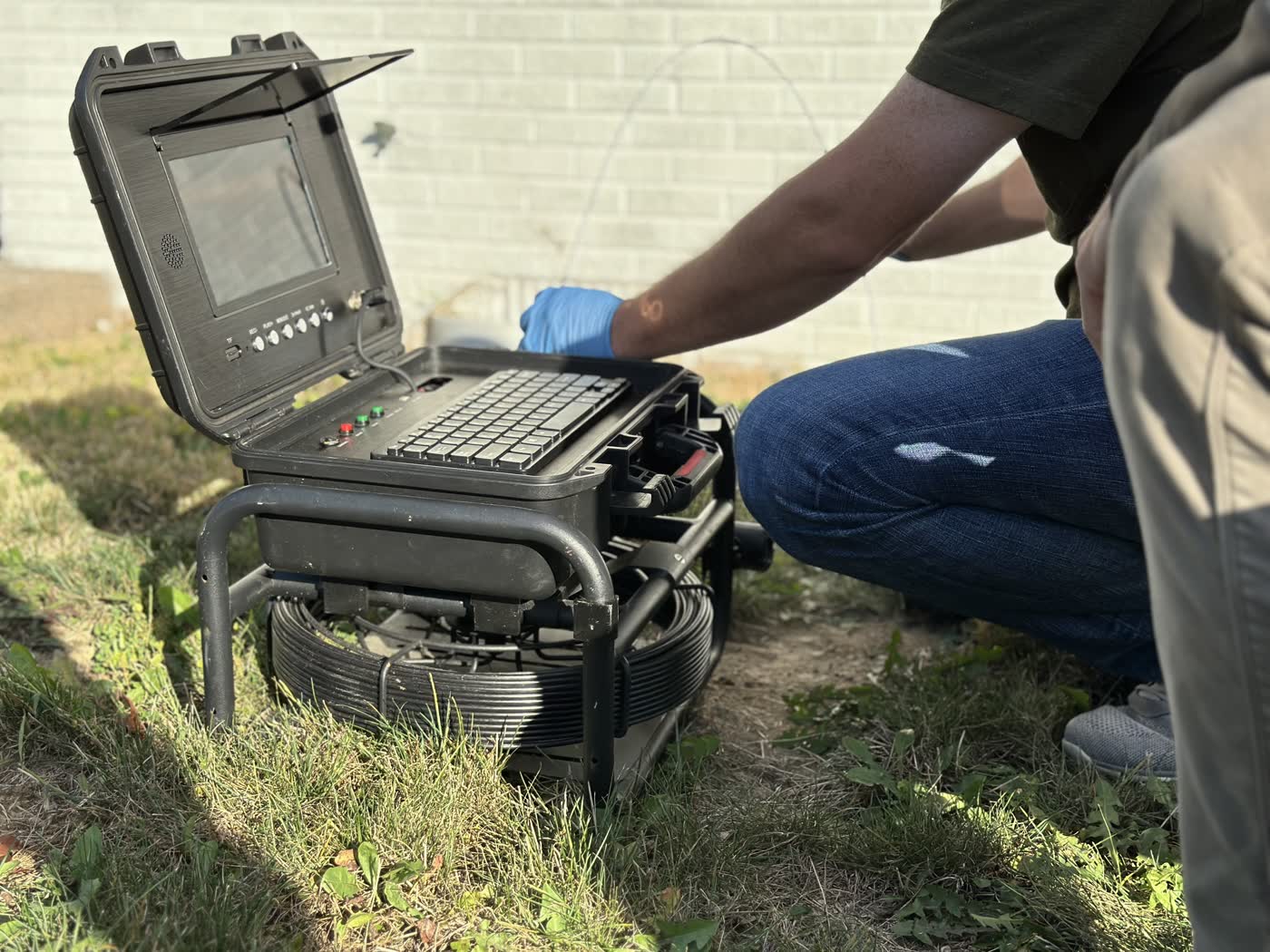
Cast iron sewer mains last 50 to 100 years with deterioration beginning after 25 years (per Balkan Plumbing's lifespan reference). That means every Marion County home built before 1980 with original cast iron is now past the 25-year deterioration mark. Most are at or past the 50-year midpoint. Indianapolis-area clay soils retain moisture and accelerate the corrosion timeline; Carter's My Plumber Indianapolis cites the same soil-acidity-driven failure pattern across Marion County (per Carter's My Plumber Indianapolis prevention guide).
On camera, Indianapolis cast iron at mid-life shows up as rust-colored scale buildup narrowing the pipe diameter. Heavy buildup creates jagged interior walls that catch debris. Worst cases show channeling where the bottom of the pipe has rusted through completely, exposing soil (per Parker and Sons cast iron corrosion reference).
The good news on Indianapolis cast iron: descaling works. Hydro-jetting handles light buildup at $350 to $600. Mechanical chain descaling handles moderate to heavy buildup at $200 to $800 (per Northwest Sewer descaling reference, per Benjamin Franklin Plumbing descaling cost). Descaling restores diameter and can extend useful life by decades. Channeled cast iron requires replacement.
Root intrusion causes more than 50% of all sewer blockages nationally (per ARS Rescue Rooter's blockage data). In Indianapolis, the rate climbs on lots with mature trees within 30 feet of the lateral. The most aggressive species are willow, poplar, maple (silver maple is the Indianapolis headline offender), oak, and elm (per Zoom Drain species reference).
Silver maple was planted heavily across Marion County's bungalow belts (Broad Ripple, Meridian-Kessler, Irvington, Crown Hill) through the 1920s to 1950s. Those trees are now 70 to 100 years old, with root systems that extend well beyond the 30-foot recommended setback for new lateral installs. On camera, Indianapolis root intrusion shows up as white, hair-like or rope-like masses growing into the line from a joint. Heavy intrusion shows a thick curtain of root material partially or fully blocking flow.
Indianapolis root intrusion repair: single intrusion clears at $1,500 to $5,000 via hydro-jetting and mechanical root cutting (per Carter's My Plumber Indianapolis pricing). Recurring intrusion at the same joint usually points to trenchless lining at $1,500 to $4,000 (CIPP creates a smooth interior that roots cannot re-enter). Per the Indianapolis prevention guidance, new laterals should sit at least 30 feet from large trees and 100 feet from very old ones (per Carter's My Plumber Indianapolis prevention).
Bellies. Indianapolis clay soils retain moisture and shift seasonally with freeze-thaw cycles. The combination drives belly formation in older lateral installs across Marion County. The pipe sags below grade and waste pools at the low point. On camera, the operator sees standing water with sediment at the low point and the camera tilts downward then back up as it travels through the sag. Real Indianapolis-context belly repair cost is $1,500 to $4,500 (per Carter's My Plumber Indianapolis belly cost). Full replacement of the bellied section runs $4,000 to $15,000.
Offsets. Settlement and root pressure push pipe sections out of alignment. Common in Marion County's older clay tile and Orangeburg installs where the pipe sections have shifted over decades. On camera, the inspector sees a step or shelf where one pipe section ends and the next begins out of line, often accompanied by root intrusion at the offset point. Repair: trenchless lining $1,500 to $4,000 (per Nuflow offset trenchless reference) or traditional excavation $50 to $250 per foot with typical project totals of $3,000 to $7,000 (per Express Sewer offset reference).
Cracks and fractures. Marion County cracks fall into two categories: longitudinal (along the pipe length, from pressure above) and transverse (across the pipe, from settling) (per LWTech Welding crack types). Hairline cracks may not require immediate action and should be re-scoped in 3 to 5 years (per Harts Services crack reference). Indianapolis trenchless lining for cracks runs $1,500 to $4,000 via CIPP, which creates a structural sleeve inside the existing pipe.
City-tap separation. Less common in Marion County than in older eastern metros, but it does show up in pre-1960 installs where the original tap-in to the city main has settled over time. On camera, the inspector sees a visible gap or step at the city-tap connection, sometimes accompanied by visible soil intrusion or active groundwater. Repair runs $1,500 to $5,000 typical, higher if the connection sits under the street. Marion County coordination is required because the work happens at the boundary between homeowner ownership and Citizens Energy Group / city ownership (per Citizens Energy Group's service-line procedures).
Highest Orangeburg risk: 46220 (Broad Ripple / Meridian-Kessler), 46226 (Devonshire / Lawrence), 46227 (Southport), 46208 (Crown Hill / Butler-Tarkington).
Highest cast iron scale prevalence: Every pre-1980 ZIP. 46201 (Near Eastside), 46202 (Downtown), 46208 (Crown Hill), 46220 (Broad Ripple), 46226 (Devonshire), 46227 (Southport), and 46240 (Castleton).
Highest root intrusion prevalence: Bungalow belts with mature silver maple, willow, or poplar. 46220 (Broad Ripple / Meridian-Kessler), 46208 (Crown Hill / Butler-Tarkington), 46201 (Irvington), and 46226 (Devonshire).
Bellies most common: Older clay tile and Orangeburg installs in Marion County. 46220, 46226, 46227, 46208.
City-tap separation: Pre-1960 installs primarily. Rare in newer Hamilton and Hendricks county subdivisions. Use the Indianapolis ZIP risk lookup to check a specific address before scheduling.
Questions Indianapolis buyers, agents, and homeowners ask Google about specific Marion County sewer-scope findings.
Orangeburg pipe is most common in Marion County ZIPs with heavy 1945 to 1972 housing-stock concentration. 46220 (Broad Ripple / Meridian-Kessler), 46226 (Devonshire / Lawrence), 46227 (Southport), and 46208 (Crown Hill / Butler-Tarkington) are the highest-risk Indianapolis ZIPs for Orangeburg findings.
Source: Wikipedia Orangeburg · Structure Tech field guideVery common. Silver maple is the Indianapolis-specific headline offender, planted heavily in Marion County bungalow lots through the 1920s to 1950s. Roots cause more than 50% of all sewer blockages nationally, and Indianapolis sees that rate climb on lots with mature silver maple, willow, or poplar within 30 feet of the lateral.
Source: ARS Rescue Rooter · Carter's My Plumber Indianapolis preventionCast iron mains in pre-1980 Indianapolis homes show rust-colored scale buildup narrowing the pipe diameter. Heavy buildup creates jagged interior walls that catch debris. Worst cases show channeling where the bottom of the pipe has rusted through completely. Indianapolis-area clay soils accelerate the corrosion timeline.
Source: Balkan Plumbing · Parker and Sons corrosionFull Indianapolis Orangeburg lateral replacement runs $4,000 to $15,000 depending on depth, footage, and surface restoration. Trenchless options are available where access allows; standard per-foot pricing is $50 to $65, up to $250 in difficult conditions. Marion County permit and connection fees add roughly $2,766 ($2,530 connection plus $236 permit) when the work involves the city-main connection.
Source: Patriot Dirt · Angi Indianapolis · Marion County CodeIt depends on the severity. A shallow belly with minor pooling can sometimes be lined trenchlessly at $1,500 to $4,000. A pronounced sag with active blockage history needs excavation at $1,800 to $4,500 for spot work or $1,500 to $3,500 for full section replacement. Marion County clay soils and freeze-thaw cycles make bellies one of the more common Indy findings.
Source: Carter's My Plumber Indianapolis belly cost · A.S. Plumbing belly costSometimes. Marion County cracks fall into longitudinal (from pressure above) and transverse (from settling) types. Hairline cracks may not require immediate action and should be re-scoped in 3 to 5 years. Significant cracks with visible water intrusion are typically lined trenchlessly via CIPP at $1,500 to $4,000.
Source: LWTech Welding crack types · Harts ServicesMarion / Hamilton / Hendricks specifics. Housing-era risk by ZIP. Indianapolis defect prevalence.
Marion County specifics, Citizens Energy permit context, pay-after-inspection billing.
ZIP-by-ZIP overlay pattern. Septic homes outside Marion. Indiana state code.
Looking for the national defect guide? National defect dictionary →