
A sewer scope inspection runs a high-resolution camera through the sewer lateral from a cleanout out to the city tap, recording everything the camera sees. The deliverable is video plus a written report. Standard home inspections never enter the lateral, which is why the scope is a separate product.
The lateral is the underground pipe that carries waste from a home's plumbing stack out to the city sewer main. In Marion County, Indianapolis, the homeowner owns the lateral from the foundation to the connection at the public main (per Citizens Energy Group's service-line guidance). Other municipalities draw the property line at the curb or at the easement. Either way, lateral repairs almost always land on the homeowner's invoice, not the utility's.
A sewer scope inspection (also called a sewer camera inspection or sewer line camera inspection) is the only practical way to see the inside of a lateral without digging. The inspector inserts a flexible, push-rod-mounted camera at an access point. The camera, lit by an LED ring, transmits video to a monitor while the rod is fed through the line. The footage is saved and the inspector annotates depth and distance to each finding.
The plain-English version from Rocket Mortgage matches: a sewer scope inspection is "a process where a plumber sends a small camera through your sewer line to look for any potential problems," conducted to identify cracks, blockages, root intrusion, or other defects that a standard home inspection cannot reach (per Rocket Mortgage's buyer guide). Spectora's industry write-up uses the same framing: a high-definition camera fed through the lateral, recording video the buyer can keep (per Spectora's industry explainer).
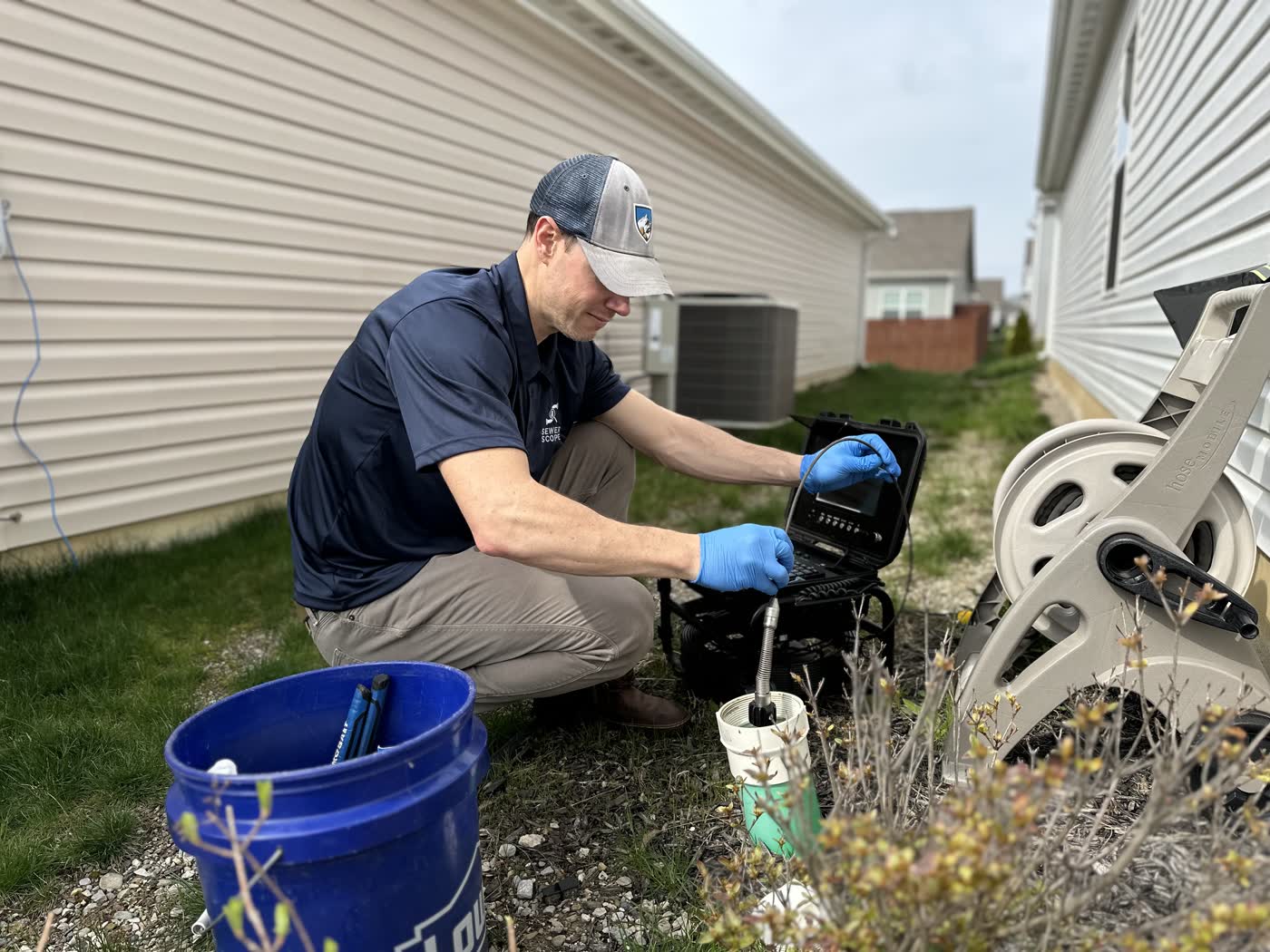
The camera head is roughly the diameter of a hockey puck (sizes vary by manufacturer). It is mounted to a fiberglass push rod that the inspector feeds into the line. An LED ring around the lens lights the pipe. A transmitter beacon embedded near the head broadcasts a radio signal that the inspector can locate from above ground with a wand. That locator function is critical: when a defect is found at 47 feet, the inspector marks the spot in the yard so the buyer's plumber knows exactly where to dig (or where to start the trenchless lining).
Footage records to the camera's on-board monitor and exports to MP4. Most specialist inspectors hand off the video file, a PDF report with video capture, and the depth and distance markers for every finding. Pillar To Post, one of the largest national home-inspection brands, describes the deliverable as a "video and written report of the inspection" given directly to the buyer (per Pillar To Post's sewer scoping service page).
Camera access matters. The cleanest run starts at an external cleanout (a capped vertical pipe usually near the foundation). If the home has no cleanout, the inspector may pull a toilet to access the stack. A few homes have no practical access at all. A reputable inspector tells the buyer about an access problem before starting, not after.
Root intrusion accounts for more than half of all sewer blockages (per ARS Rescue Rooter's industry data). Roots find joints, work into the line, and grow until the lateral is choked. Aggressive species include willow, poplar, maple, oak, and elm.
Pipe material identification matters because some materials are time bombs. Orangeburg pipe, manufactured from the 1860s through the 1970s and most commonly installed between 1945 and 1972, was made of wood pulp sealed with coal tar pitch. Its useful life is roughly 50 years under ideal conditions, with known failures inside 10 years and deformation common after 30 years (per InspectAPedia's Orangeburg reference). Cast iron mains last 50 to 100 years but begin deteriorating around the 25-year mark (per Balkan Plumbing's lifespan reference).
The full set of camera-detectable defects breaks down into seven types, each covered in our visual defect guide:
InterNACHI's published Standards of Practice for home inspections cover the visible, accessible components of the structure. The buried sewer lateral is not in scope. A home inspector flushes toilets, runs sinks, looks for leaks at fixture connections, and inspects accessible drain piping. The inspector does not insert a camera into the cleanout (per InterNACHI's sewer scope inspection guidance).
Pillar To Post, which operates one of the largest home-inspection franchises in North America, lists sewer scoping as a "specialty add-on service" outside the standard inspection package (per Pillar To Post's add-on services page). The distinction matters during the option period of a real estate transaction. A buyer who orders only the standard inspection will not learn about Orangeburg, cast iron scale, root intrusion, or bellies until the kitchen sink backs up two months after closing.
If the home inspector also performs the scope, the report is usually rolled into the larger inspection package. If a specialist runs the scope (as Sewer Scope does in every metro we serve), the deliverable is its own report. Either way, the scope is a separate service, performed with separate equipment, by a separately qualified operator.
The 1980 line is not arbitrary. Orangeburg pipe was discontinued in the 1970s but installed widely from 1945 through 1972 (per Wikipedia's Orangeburg reference). Cast iron mains installed before 1980 are now past the 25-year mark where deterioration begins (per Balkan's lifespan reference). PVC, the dominant material in post-1980 construction, is more durable, though joints can still leak and roots can still find them.
A buyer guide from Redfin frames the decision more directly: a sewer scope is worth ordering whenever the home is older, when there are mature trees in the yard, when the seller has not lived there long, or when the buyer has any reason to believe drains have been slow (per Redfin's buyer-side guide). A trenchless plumbing reference (Nuflow) frames it as straight insurance: a $200 to $300 inspection lets the buyer negotiate a several-thousand-dollar repair while the deal is still open (per Nuflow's pre-purchase guide).
The cost of skipping the scope is what real estate boards point to. The Three Lakes Association of Realtors describes a sewer scope as a buyer's best low-cost defense against post-closing repair surprises that the standard home inspection cannot catch (per Three Lakes Association of Realtors' buyer note).
The on-site visit for a standard residential lateral runs roughly half an hour to an hour. Alpha Environmental's industry guide pegs the typical residential scope at 30 to 60 minutes (per Alpha Environmental's duration reference). The actual camera run is closer to 20 to 30 minutes once the inspector has located the cleanout and set up the equipment. Total Home Inspection's parallel reference puts most residential scopes in the same range, with variation by lateral length and access difficulty (per Total Home Inspection's duration reference).
What lengthens a scope: no accessible cleanout (the inspector pulls a toilet, then resets), longer-than-typical laterals (commercial sites or estate lots), blockages that need a quick hydro-flush to clear the camera path, or a homeowner who wants the operator to walk through the live feed in detail. None of those add a full hour. Most scopes are out the door by lunch even when the appointment was scheduled for first thing in the morning.
The report turnaround at Sewer Scope is roughly 24 hours from camera-back-in-the-truck. The platform we operate on packages the video plus PDF and sends one shareable link to the buyer, the buyer's agent, and the home inspector if they were on site.
This is where the industry has a quiet conflict of interest. A plumber will run the scope (and many do), but a plumbing company's business model is repairs. The same person who finds the defect also bids the fix. The incentive to find expensive problems is structural, not personal. A buyer reading the report cannot tell whether the offset at 41 feet is a $3,000 trenchless lining or a $9,000 dig-and-replace until they ask a second plumber for a quote.
A specialist sewer scope inspector does the inspection only. No repair quote attached. No referral fee. No bid in the inbox the next day. InterNACHI publishes specialist standards for sewer scope inspection (per InterNACHI's sewer scope standards). Pillar To Post markets its scope as a standalone add-on rather than a repair lead-in (per Pillar To Post's scope page).
At Sewer Scope, the specialist standard is the entire business. Every metro we operate (Indianapolis, Cincinnati, Denver, Fort Wayne) runs the same -backed workflow, the same camera deliverable, and the same "no repair quote attached" rule.
Below are the questions Google's People Also Ask panel surfaces for this topic, paired with sourced answers. No fabrication. Every claim links back to its origin.
A sewer scope inspection is a visual examination of the sewer lateral performed by feeding a small, flexible, high-resolution camera into the line at an access point (usually a cleanout). The camera runs from the house to the connection at the city main, recording video of the entire run. The report documents pipe material, depth, distance to each finding, and any defects visible to the camera.
Source: Rocket Mortgage · SpectoraBecause the homeowner owns the lateral, and a defect found before closing is negotiable in a way that a defect found after closing is not. Repair ranges run from an amount that varies by plumber for descaling at the low end to an amount that varies by plumber for a full lateral replacement at the high end. A scope costs $200 to $300 and is the only way to see the line without digging.
Source: Rocket MortgageThe national average for a residential sewer scope inspection runs $200 to $300, with some markets dipping to $159 and others reaching $500 depending on access and lateral length. Indianapolis-area pricing typically lands in the $200 to $300 range. Bundled with a home inspection, the scope is sometimes discounted $50 to $75 because the inspector is already on site. Full breakdown in our cost guide.
Source: HomeGuide · AngiA typical residential sewer scope inspection takes 30 to 60 minutes on site, with the camera run itself running 20 to 30 minutes. Larger commercial lines or homes without an accessible cleanout take longer because the inspector has to set up an alternative access path.
Source: Alpha Environmental · Total Home InspectionRoot intrusion (more than 50% of all sewer blockages), pipe material (PVC, cast iron, clay, Orangeburg), scale and corrosion, cracks and fractures, offset joints, bellies and sags, blockages, and separation at the city tap. Full visual guide in our defect dictionary.
Source: ARS Rescue RooterA standard home inspection does not include the sewer lateral. InterNACHI's Standards of Practice exclude underground systems beyond the structure. The home inspector tests fixtures and visible piping inside the home. The sewer scope is its own add-on or specialist service that covers the buried run the home inspection cannot reach.
Source: InterNACHIA specialist sewer scope inspector or a properly trained home inspector. A plumbing company will scope, but their incentive structure tilts toward repair work. A specialist whose only product is the report has nothing to sell beyond the inspection itself.
Source: InterNACHI · Pillar To PostNo, not on city-sewer homes. FHA requires septic inspection for homes on septic systems and applies specific distance separation rules from drinking water sources. FHA does not require a sewer scope for homes on a city sewer connection. Individual lenders may add overlays beyond FHA baseline. Full breakdown in our FHA guide.
Source: FHA News Blog · FHA.comNational range, Indianapolis specifics, bundled-vs-standalone pricing, and the "pay at close" model.
The seven defects, sourced photos, real repair costs, and how to read the report your inspector hands you.
Truth and lender overlays. FHA doesn't require a scope on city sewer. Many lenders effectively do.
Looking for the Indianapolis-specific version of this guide? Indianapolis sewer scope inspection guide →