
Hamilton County is the fastest-growing county in Indiana, and the Indianapolis-metro county with the strongest newer-construction profile. Most laterals here are PVC, mid-life, and carry a lower defect-find rate than the older Marion County cores, though even newer homes fail a sewer scope about 40% of the time, so a scope is still worth it. That makes the scope conversation different from the Marion County one. In Carmel, Fishers, and Westfield the question is not whether the lateral has Orangeburg (it almost never does). The question is whether the property is one of the older Hamilton County pockets, including Old Town Carmel circa 1900 to 1940, downtown Noblesville circa 1880 to 1920, and the Geist-perimeter 1960s subdivisions, where the lateral is clay tile or first-generation cast iron and the same defect catalog applies. A scope clarifies which group the property falls into in about 25 minutes.
Hamilton County is roughly 402 square miles directly north of Marion County. The 2020 census put the population at 347,467, up from 274,569 in 2010, which is a 26.6 percent gain over the decade per the U.S. Census Bureau QuickFacts. That growth rate is what makes the county's housing stock so different from Marion County's. The vast majority of Hamilton County homes selling today were built after 1990, which is comfortably inside the PVC lateral era.
Carmel is the county's largest city. The Carmel Arts and Design District (Range Line Road, Main Street, the Old Town quadrant) holds the oldest housing stock in the county, with original construction running from 1900 to 1940. Original laterals on these blocks were vitrified clay tile in short mortared sections, much of it now replaced once. The Village of WestClay (developed late 1990s through 2000s) and Bridgewater Club neighborhoods are newer PVC throughout. Median Carmel sale prices in 2025 ran around $509,000 to $560,000 across 46032 and 46033, which gives a sense of the housing-stock concentration: high-end newer construction with a small historic core.
Fishers grew explosively from the 1990s through the 2010s. The Nickel Plate District (downtown Fishers along the old Nickel Plate rail line) is the city's modern center, mostly post-2010 mixed use and condos with new PVC lateral runs. The 1990s subdivisions across 46037 and 46038 (Geist Reservoir perimeter, Sand Creek, Hamilton Town Center area) are heavy PVC. The exception worth flagging: a handful of 1960s and 1970s ranches and lake-cottage conversions on the immediate perimeter of Geist Reservoir, where original laterals were vitrified clay or first-generation Orangeburg. Lake-perimeter homes with older builds warrant a scope.
Noblesville is the historic county seat. The downtown square (Logan Street, 8th Street, Conner Street, around the Hamilton County Courthouse) holds the county's oldest residential stock, with original homes dating from the 1880s through the 1920s. Original laterals there are clay tile, in some cases replaced once during the 1945 to 1972 era with Orangeburg. The newer Noblesville subdivisions (Morse Reservoir perimeter, Promise Road corridor, 46060 / 46062 outer ring) are post-1990 PVC. Westfield (46074) is almost entirely 1995-and-newer development with very low pre-1980 housing stock.
Soil in Hamilton County is similar to Marion County but slightly more rolling. The USDA NRCS Web Soil Survey maps Brookston silty clay loam in the lower areas, Crosby silt loam across the gentle uplands, and Miami silt loam on the rolling ground rising toward the Tipton Till Plain north of Westfield. The same clay-soil moisture retention, freeze-thaw cycling, and belly-formation risk applies, and while the much-younger lateral installs carry a lower defect-find rate, even newer homes fail a sewer scope about 40% of the time, so a scope is still worth it.
The tree canopy in Hamilton County is also younger and more mixed than Marion County's bungalow belts. Newer subdivisions were planted with a deliberate species mix (red maple, sugar maple, sweetgum, redbud, pin oak) rather than the silver-maple monoculture of 1920s Indianapolis. The Indiana Department of Natural Resources Division of Forestry catalogs the regional canopy in detail (per Indiana DNR Forestry). Root-intrusion findings in Hamilton County track the lot age more than the tree species. A 50-year-old Geist oak over a 1968 clay-tile lateral will show roots. A 15-year-old maple over a 2008 PVC lateral usually will not.
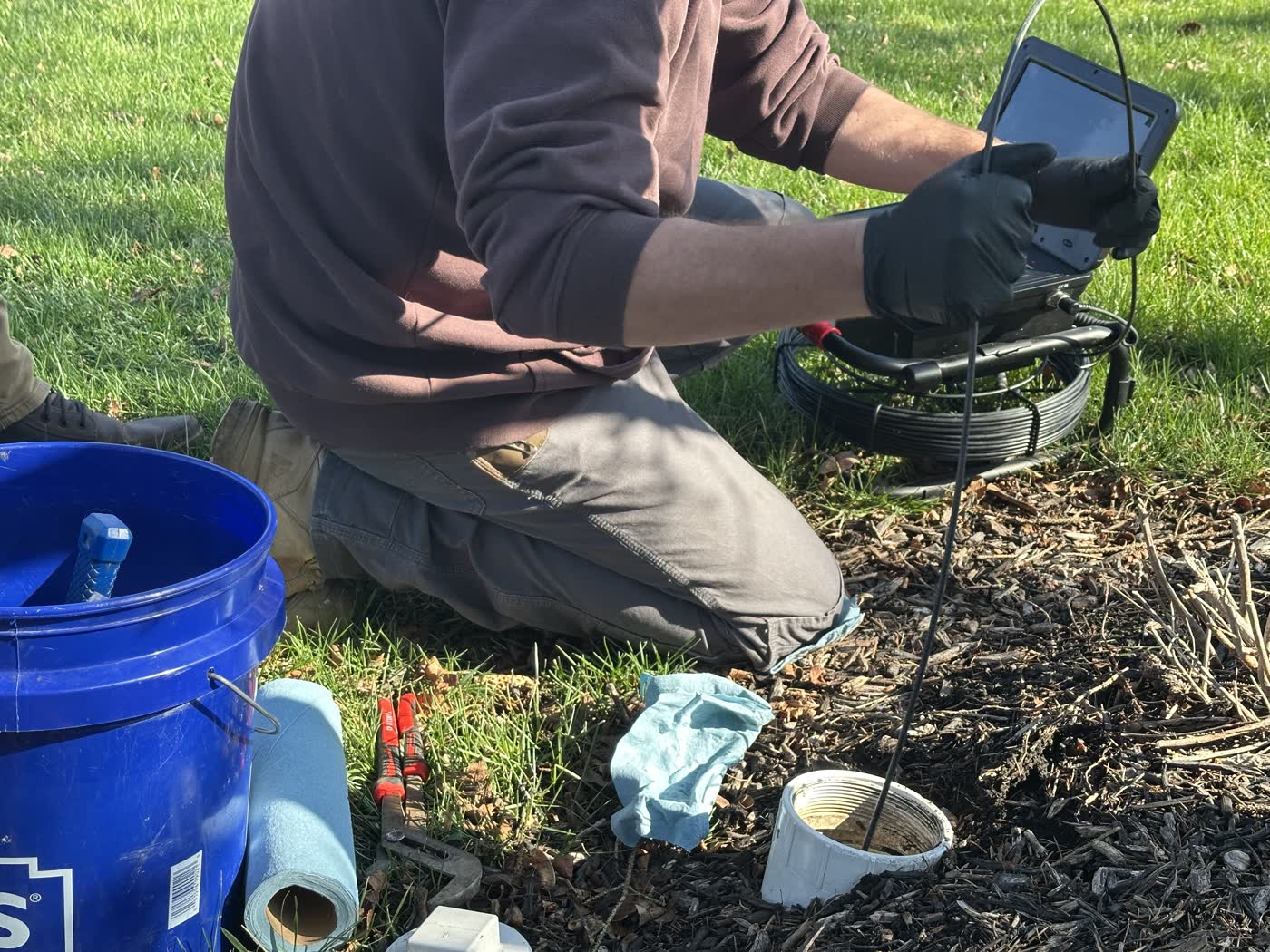
1. PVC joint separation and root intrusion at joints (most common Hamilton County finding). PVC laterals have a long useful life (50+ years documented and counting, with proper installation per Uni-Bell PVC Pipe Association) but they are only as good as the joint glue and the soil bedding underneath. In Hamilton County's clay-rich soils, freeze-thaw movement gradually pulls PVC joints apart over a 20 to 30 year window. The gap is usually small (a quarter inch or less) but it is enough for moisture-seeking maple or oak roots to find. On camera: visible hairline roots threading through a clean PVC joint, or a small step where the PVC section has shifted. Repair is typically trenchless lining at the joint ($1,500 to $4,000) or spot excavation at the joint ($1,500 to $3,500). The American Society of Civil Engineers tracks root intrusion as one of the leading causes of sanitary sewer overflows nationally (per ASCE Infrastructure Report Card on wastewater).
2. Clay tile and first-generation Orangeburg in the older pockets (Old Town Carmel, downtown Noblesville, Geist perimeter 1960s). The defect catalog here mirrors Marion County's: deformed Orangeburg, scaled cast iron, root masses, bellies, offset joints. The difference is concentration. Where 60 percent of Marion County's pre-1980 housing stock is in scope-finding territory, only roughly 8 to 12 percent of Hamilton County's housing stock falls in the pre-1980 window. A buyer's agent who knows the older Hamilton County pockets will steer the scope conversation differently from a buyer's agent who treats every Hamilton County listing as a moderate-risk newer build, since even newer builds fail a scope about 40% of the time. The Hamilton County Soil and Water Conservation District (per Hamilton SWCD) publishes geological and historical land-use references that help calibrate by neighborhood.
3. Belly formation in early 1990s laterals (Carmel and Fishers). PVC laterals installed in the early-to-mid 1990s sometimes show belly formation today because trench-bedding standards varied across the builder boom of that era. Indianapolis-area soils plus a borderline-shallow bury depth plus a quarter-inch of settling per year for 30 years equals a measurable belly. On camera: the camera tilts down then back up through a low spot, and water pools in the dip. Belly repair runs $1,500 to $4,500 for the section work in Hamilton County, with comparable cost to Marion County since the per-foot excavation rates do not vary much across the metro.
4. Cast iron stack and lateral stub at the foundation wall (any pre-1990 build). Even when the lateral itself is PVC, the cast iron stack inside the wall and the cast iron stub through the foundation wall is mid-life on any pre-1990 Hamilton County home. Scale builds up at the transition, and corrosion at the foundation penetration occasionally allows soil intrusion. On camera: the first 4 to 8 feet from the camera entry shows narrower diameter and rough scale on the bottom. Indianapolis-area descaling rates run $200 to $800 per Benjamin Franklin Plumbing's descaling cost reference.
One additional Hamilton County variable: Geist Reservoir homes on septic. Many lake-perimeter Geist properties (especially older 1960s lots that predate Fishers sewer expansion) are still on private septic systems administered by the Hamilton County Health Department. A pre-purchase scope on a septic property terminates at the tank inlet rather than a city tap, and the same camera also documents the inlet condition. Indiana State Department of Health on-site sewage rules (per IDOH On-Site Sewage Systems Program) apply.
Hamilton County inspections run on the same platform as every other Sewer Scope job. Booking by phone at (317) 210-0084 or online. Same-week appointment standard. The technician arrives in the inspection-period window, locates the cleanout (rare-to-find in Old Town Carmel pre-1940 builds, easy-to-find in any 1995-or-later subdivision), runs the camera from access to city tap with footage marked, and packs out.
Hamilton County's longer suburban lateral runs (some Geist and Bridgewater Club properties have laterals exceeding 150 feet from house to tap) sometimes push the on-site time to the longer end of the 30-to-60 minute typical window. report turnaround is roughly 24 hours, with the same buyer, agent, plumber, lender distribution.
For homes built after 1990, the lateral is almost always PVC, so the defect-find rate is lower than older areas, but it is not low: even newer homes fail a sewer scope about 40% of the time, so a scope is still worth it as cheap insurance and to document the pipe condition for the buyer's records. For Hamilton County homes built before 1980, including Old Town Carmel, downtown Noblesville, and Geist-perimeter 1960s subdivisions, a scope is strongly recommended. The early 1990s window (1990 to 1996) also deserves a scope because PVC bedding and joint standards varied widely during the early builder boom.
Source: Uni-Bell PVC Pipe Association · Sewer Scope Indianapolis camera logCarmel Utilities handles Carmel sewer service. Fishers contracts with Citizens Energy Group on most service areas. Westfield Public Works operates the Westfield system. Noblesville Utilities runs Noblesville. Each authority sets its own connection fees, lateral ownership boundary, and contractor licensing requirements. Confirm jurisdiction at the buyer's address before any repair quote.
Source: Carmel Utilities · Westfield Public Works · Noblesville UtilitiesHamilton County is mapped predominantly Brookston silty clay loam and Crosby silt loam with Miami silt loam on rolling terrain. The pattern is similar to Marion County, and the same wet-dry cycling drives belly formation in older lateral installs. Hamilton County's later build dates mean fewer of those laterals are at end of life, but the soil mechanics are identical to the city core.
Source: USDA NRCS Web Soil Survey · Hamilton County Soil and Water Conservation DistrictHamilton County has a more mixed canopy than the Marion County bungalow belts. Maple species (silver, sugar, red) and oak (pin, red, bur) dominate. Mature oak on Geist-area 1960s lots and along the Nickel Plate corridor produces aggressive root systems. The older the lot the higher the root-intrusion finding rate. Old Town Carmel and the original Noblesville town square score highest on root-intrusion frequency in our Hamilton County log.
Source: Indiana DNR ForestryHamilton County is dominated by post-1990 construction. Most laterals are PVC and in mid-life. The lateral defect-find rate is materially lower than Marion County's bungalow-belt rate. The exceptions are concentrated: Old Town Carmel (1900-1940), downtown Noblesville (1880s-1920s), and Geist-perimeter 1960s subdivisions. A scope is still cheap insurance everywhere, and the Hamilton County buyer pool is increasingly ordering them on every contract as a standard line item.
Source: U.S. Census Hamilton County QuickFacts · MIBOR Realtor AssociationIt depends on the specific street and the original build year. Many lake-perimeter Geist Reservoir properties (especially 1960s lots that predate Fishers sewer expansion) are still on private septic systems administered by the Hamilton County Health Department. A pre-purchase scope on a septic property terminates at the tank inlet rather than a city tap, and the camera also documents tank inlet condition.
Source: Indiana State Department of Health On-Site Sewage Systems ProgramHamilton County is the highest-volume buyer market in the Indianapolis metro for MIBOR agents (per MIBOR Realtor Association). The scope conversation differs from Marion County's: instead of "this is mandatory due diligence on a pre-1980 home," it is "this is cheap insurance on a $500K newer home and mandatory on the older pockets." Same professional report and high quality video. Same 24-hour turnaround. Same clean handoff with no repair upsell. The Realtor Partner Program covers the pre-sale scope add-on and pay-after-inspection billing.
Old Town 1900-1940 plus newer Village of WestClay PVC. Carmel Utilities owns the main.
Nickel Plate post-2010 plus 1990s sub PVC plus Geist 1960s clay-tile pockets.
Historic downtown square 1880-1920 plus Morse Reservoir perimeter newer subdivisions.
The dense pre-1980 Indianapolis housing stock just south. Highest defect-rate county in the metro.