
Marion County is where Sewer Scope was founded, and the county where we have logged more pre-1980 lateral footage than any single-truck plumber in the metro sees in a year. The reason matters: Marion County's housing stock concentrates almost every defect type we catalog. Orangeburg lateral failure in Irvington and Devonshire. Cast iron scale across the Meridian corridor. Silver-maple root intrusion in every bungalow belt from Broad Ripple to Garfield Park. Belly formation in the Crosby silt loam under Beech Grove and Speedway. One inspection. About 25 minutes on site. Every defect type a Marion County lateral can produce, written into a report your buyer's plumber can act on before closing.
Marion County is the consolidated city-county of Indianapolis, covering roughly 396 square miles with a 2020 census population of 977,203, per the U.S. Census Bureau QuickFacts. The housing stock did not arrive in one wave. It arrived in layers, and the lateral material under each home tracks the year the neighborhood was platted.
The oldest layer is the urban core. The Near Eastside (46201), Irvington, Crown Hill (46208), Butler-Tarkington, and the older edges of Fountain Square and Meridian-Kessler were platted between the 1870s and the 1920s. Original laterals on these blocks were vitrified clay tile in short 2 to 4 foot sections with mortared joints. Many have been replaced once already, often during the 1945 to 1972 Orangeburg-replacement era, which means the "replacement" lateral is itself now Orangeburg and at the end of its useful life. The bungalow belt around Broad Ripple (46220) and the streetcar neighborhoods along College Avenue went up in the 1920s through 1940s with similar clay tile that has aged in similar ways.
The next layer is the postwar ring. Devonshire and Lawrence (46226), Southport (46227), Speedway (46224), Beech Grove, and parts of Castleton (46250) were built between 1945 and 1972. This is the textbook Orangeburg window. The bituminized fiber pipe, also called Orangeburg, was the budget lateral of choice across the postwar boom because it was lightweight and easy to install, per the Wikipedia reference on Orangeburg pipe. Its useful life is roughly 50 years under ideal conditions. Every original Marion County install is now past that window.
The outer ring (46250, 46260, 46268, 46278, 46239) built between 1970 and 1990 transitions to PVC and ABS plastic laterals. Cast iron mains inside homes from this era are now hitting the 25 to 50 year deterioration window where scale accumulation reduces effective diameter by 30 to 60 percent. The newest Marion County housing on the far edges and infill is post-2000 PVC with mid-life root intrusion as the primary defect mode.
Underlying all of this is the soil. The USDA Natural Resources Conservation Service maps Marion County as predominantly Crosby silt loam with Brookston silty clay loam in low areas (per the USDA NRCS Web Soil Survey). Both retain moisture, swell with saturation, and contract with Indiana freeze-thaw cycles. Bellies form. Cast iron corrodes faster than it would in sandy soil. Clay-tile joint seals fail. The soil profile is the single biggest variable that separates Marion County repair costs from suburban Hamilton County peers on the same defect type.
The tree canopy is the second variable. Indianapolis aggressively planted silver maple along bungalow streets in the 1920s through 1960s because it grows fast and tolerates urban stress. Indiana DNR's urban forestry references describe silver maple's shallow, aggressive, moisture-seeking root system as one of the leading drivers of underground utility intrusion (per Indiana DNR Community and Urban Forestry). Roots account for more than 50 percent of sewer blockages nationally, per ARS Rescue Rooter, and Marion County's bungalow belts are at the high end of that distribution.
1. Orangeburg lateral deformation (peak prevalence: 46201, 46226, 46227, 46208). The defect taxonomy starts here because it is the most expensive surprise a Marion County buyer can take to closing. Orangeburg pipe is wood pulp sealed with liquefied coal tar pitch, manufactured from the 1860s through the 1970s, with peak U.S. residential use 1945 to 1972 (per Structure Tech's Orangeburg field guide). It deforms into an oval, then a partial collapse, then a full failure. Useful life is roughly 50 years and known failures have occurred in as little as 10 years where soil pressure was unusual. On camera the defect is unmistakable: corrugated dark brown to black walls, with the round profile pinched to oval or worse. Full lateral replacement in Marion County runs $4,000 to $15,000 depending on depth and surface restoration, per Patriot Dirt's Indianapolis cost data. The Marion County permit and connection fees ($236 permit, $2,530 connection per Citizens Energy Group) sit on top.
2. Cast iron scale and channeling (peak prevalence: pre-1980 builds across all Marion County). Cast iron sewer pipe has a 50 to 100 year lifespan with deterioration commonly beginning after 25 years, per Balkan Plumbing's lifespan reference. In Crosby silt loam the timeline accelerates. Scale builds up inside the pipe walls, narrowing the effective diameter by 30 to 60 percent and trapping waste. In severe cases the bottom of the pipe rusts through completely (called "channeling"). On camera: jagged orange-brown buildup with a worn-smooth channel along the bottom. Descaling alone runs $200 to $800 and can restore diameter for another decade or more. Full replacement runs into thousands. Indianapolis-area soil acidity is the variable that decides which path applies.
3. Silver-maple root intrusion (peak prevalence: 46220, 46208, 46201, 46205 bungalow belts). Mature silver maple roots find their way into clay-tile joints, Orangeburg seams, and even PVC fittings if there is a hairline gap. ASCE's Civil Engineering reference catalogs root intrusion as one of the leading failure modes on aging gravity sewer infrastructure (per ASCE Infrastructure Report Card on wastewater). On camera in Marion County we routinely see fine hair-roots threading through joints in pre-1972 laterals, and rope-thick roots filling 30 to 80 percent of the pipe diameter in older blocks where street trees are 70+ years old. Hydro-jetting for clearing runs $350 to $600. Trenchless lining for recurring intrusion zones runs $1,500 to $4,000 per Carter's My Plumber Indianapolis.
4. Bellies in clay-soil laterals (peak prevalence: any Marion County install pre-1980). A belly is a low spot where the lateral has sagged below grade. Waste and water pool at the dip. Indianapolis Crosby silt loam plus freeze-thaw cycling plus the casual original-install standards of the 1950s and 1960s combine to make bellies common in the postwar Marion County housing stock. On camera the camera floats through standing water. Belly repair runs $1,500 to $4,500 for the section work, with full replacement of the sagged grade $4,000 to $15,000 depending on depth, per Carter's My Plumber Indianapolis belly cost data. Trenchless lining cannot fix a sagged grade. The pipe has to come up, the grade has to be re-set, and the line has to go back down.
Two further notes worth recording. First, the Indiana State Department of Health publishes guidance on private sewer system inspections (per IDOH On-Site Sewage Systems Program) that applies primarily outside Marion County in septic-served areas of Hendricks and outer suburbs, but the same scope camera also documents septic-system inlet conditions when a property's lateral terminates at a tank rather than the city main. Second, the City of Indianapolis Department of Public Works flags city-tap separation as a category that requires the most expensive lateral repair in the metro because of street-cut, traffic-plate, and bonded-contractor requirements, with typical tap-side repairs running $1,500 to $5,000 or more, per Marion County Code of Ordinances.
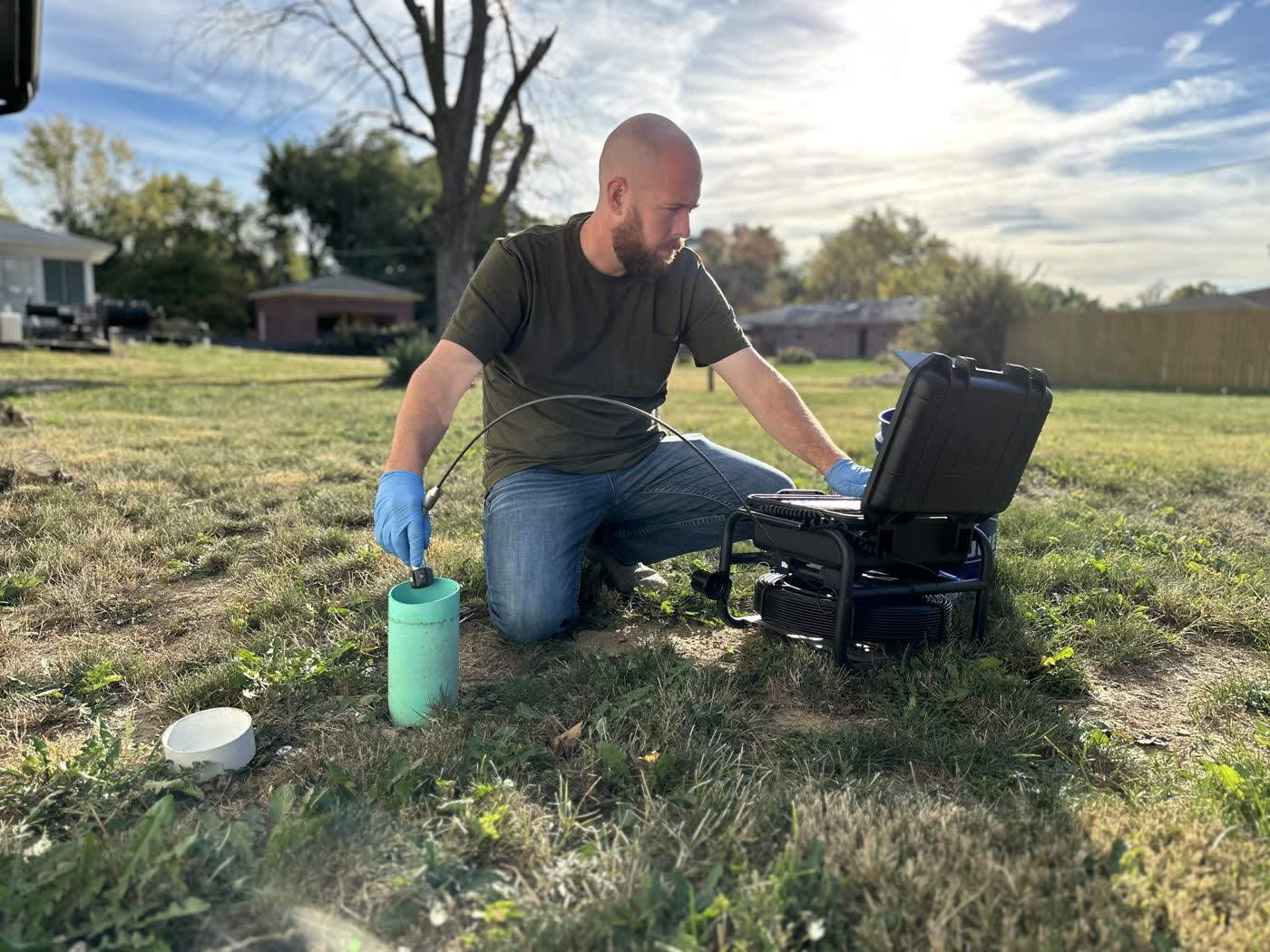
Every Marion County job runs through the same booking and reporting platform that every Sewer Scope metro operates on. The buyer or buyer's agent books the appointment online or by phone at (317) 210-0084. The technician arrives in the inspection-period window, locates the cleanout (or pulls a toilet if there is no accessible access point, common in pre-1950 Indianapolis homes), runs the camera from access to city tap with footage marked, and packs out. The platform packages full-resolution HD video plus video capture of every finding into a single shareable PDF and video link. Turnaround is roughly 24 hours from camera-back-in-the-truck.
The report and shareable video go directly to you, the customer, so you can pass them along to your agent, lender, plumber, or anyone else, exactly as you see fit. No one is decoding a different summary. The report is clean: no kickbacks, no co-marketing strings, no plumbing referral built into the workflow. Sewer Scope does not bid repairs. The buyer's plumber, on whatever timeline the closing allows, bids the fix from the report.
With pay-after-inspection billing, the invoice is sent as soon as the report is ready and the report is emailed automatically. No deposit and no check on inspection day.
Sewer Scope Indianapolis covers all of Marion County. Selected ZIPs and the neighborhoods they cover:
Outside this list? Call (317) 210-0084. We cover the full Marion County footprint and most of Hamilton, Hendricks, Hancock, Johnson, Boone, and Morgan county adjacent areas on a same-week schedule.
Marion County does not mandate a sewer scope for a private residential transaction. There is no statute, no inspection-board rule, no MIBOR-required disclosure that compels one. What Marion County does require is that any sewer-lateral repair or replacement use a licensed contractor listed, insured, and bonded with the City of Indianapolis, with sewer connection fees of $2,530 and permits around $236. A pre-purchase scope is the buyer's only practical way to surface those costs before they become the buyer's costs.
Source: Marion County Code of Ordinances · Citizens Energy GroupThe homeowner owns the lateral from the foundation to the connection point at the city main, per Citizens Energy Group's service-line guidance. Citizens Energy Group owns and maintains the main. Every defect on a Marion County lateral scope is a homeowner cost, which is why ordering the scope before closing matters: it is the last point in the transaction where the cost can be negotiated rather than absorbed.
Source: Citizens Energy Group service-line guidanceYes. Marion County neighborhoods built between 1945 and 1972 carry significant Orangeburg lateral risk: parts of Devonshire (46226), Southport (46227), Eastside Irvington (46201), Crown Hill (46208), and pockets of Broad Ripple replacement work where original clay tile was swapped during the Orangeburg era. Useful life is approximately 50 years. Every original install is now past that window. Known failures have occurred in as little as 10 years where soil pressure was unusual.
Source: Wikipedia Orangeburg reference · Structure Tech field guideMarion County is mapped predominantly Crosby silt loam with Brookston silty clay loam in low areas, per the USDA NRCS Web Soil Survey. Those soils retain moisture, swell when saturated, and contract through freeze-thaw cycles. The behavior accelerates cast iron corrosion, drives belly formation in poorly compacted laterals from the 1945 to 1980 build era, and pressures clay-tile joints out of alignment over decades.
Source: USDA NRCS Web Soil Survey · Indiana Department of Environmental ManagementSilver maple was the dominant street and lot tree planted across Indianapolis bungalow belts from the 1920s through the 1960s, prized for fast growth and tolerance of urban stress. Its root system is shallow, aggressive, and moisture-seeking. Mature silver maples planted within 30 feet of a lateral routinely send roots into joints and cracks. Root intrusion accounts for more than 50 percent of sewer blockages nationally and is the single most common defect category in the Marion County bungalow belt scope log.
Source: Indiana DNR Community Urban Forestry · ARS Rescue RooterFrom the Sewer Scope Indianapolis camera log, the highest defect-rate ZIPs in Marion County are 46201 (Irvington and Near Eastside), 46208 (Crown Hill / Butler-Tarkington), 46220 (Broad Ripple / Meridian-Kessler), 46226 (Devonshire / Lawrence), and 46227 (Southport). Each has a heavy concentration of pre-1980 housing stock with Orangeburg or original cast iron laterals. Outer ring ZIPs (46250, 46260, 46268, 46278) trend lower-risk but still warrant a scope on any pre-1980 build.
Source: Sewer Scope Indianapolis camera log, cross-referenced with U.S. Census Marion County housing-era dataMarion County is the heart of MIBOR Realtor Association's footprint (per MIBOR Realtor Association), and roughly seven of every ten Indianapolis sewer scope orders come in through a buyer's or listing agent. The pay after inspection model, the 24-hour report, the clean handoff, and the no-repair-quote policy are all built for the way Indy agents actually close deals. About 80% of our inspections turn up some deferred maintenance on the sewer line, so a pre-sale scope on your Marion County listing gives the seller a real advantage in negotiations and helps the buyer avoid any unwanted (and sinky) surprises after closing.
Carmel, Fishers, Noblesville, Westfield. Newer PVC stock with mixed older pockets in Carmel's Old Town and Noblesville's downtown square.
Avon, Brownsburg, Plainfield. Heavy 21st-century build profile. Mixed sand-clay soil that behaves differently from Marion County's Crosby silt loam.
Boone County town inside the Indianapolis metro. 1880s brick-paved historic village with vitrified clay laterals plus newer outer subdivisions on PVC.