
Hendricks County is the Indianapolis metro's newest county by housing-stock age. Brownsburg, Avon, and Plainfield grew through the late 1990s and early 2000s with PVC laterals throughout, and the suburban defect-find rate is lower than the older Marion County cores, though even newer homes fail a sewer scope about 40% of the time, so a scope is still worth it. The Hendricks County exceptions matter though. The Plainfield and Danville town squares date to the 1880s with original clay-tile laterals. The outer townships (Liberty, Eel River, Marion, Center, Brown) include the highest concentration of private septic systems in the metro, regulated by the Hendricks County Regional Health Department. A scope clarifies which group the property falls into. The same camera also documents septic tank inlet condition where applicable.
Hendricks County covers roughly 408 square miles immediately west of Marion County. The 2020 census put the population at 174,788, up from 145,448 in 2010, a 20.2 percent gain (per the U.S. Census Bureau QuickFacts for Hendricks County). The county's growth has been concentrated in the eastern townships closest to Marion County: Brownsburg (Lincoln Township), Avon (Washington Township), and Plainfield (Guilford Township). The western and outer townships remain semi-rural.
Brownsburg (46112) is the northern of the three big eastern towns. Subdivision growth ran heavily 2000 through 2015. Most laterals are PVC and in early mid-life (10 to 25 years old, well inside useful life). The older Brownsburg town center holds a small pocket of 1920s-1940s clay-tile lateral homes, mostly off State Road 267 north of US 136. Avon (46123) lies between Brownsburg and Plainfield. Avon's 21st-century growth has been the most aggressive of any town in the metro outside Westfield. Almost all Avon housing is post-1995 PVC. There is essentially no Avon pre-1980 housing stock to speak of.
Plainfield (46168) is the southern of the three. Plainfield holds the county's most significant historic core: the original Plainfield town along Main Street, Center Street, and the East Main / Quaker corridor dates to the 1830s, with intact residential blocks running 1880s through the 1920s. Original laterals on those blocks are vitrified clay tile, some replaced. The outer Plainfield subdivisions (off Stafford Road, Vestal Road, near the Indianapolis Executive Airport, along the Plainfield Correctional Facility corridor) are post-2000 PVC. Danville (46122) is the county seat, smaller in scale, with a historic town square dating to the 1820s and surrounding residential blocks from the 1880s through the 1930s on clay tile.
The soil profile is genuinely different from Marion and Hamilton counties. The USDA NRCS Web Soil Survey maps Hendricks County as a mix of Crosby silt loam (eastern county, similar to Marion), Brookston silty clay loam (low and wet areas), and Miami silt loam plus sandy outwash soils along White Lick Creek and Mill Creek (per the USDA NRCS Web Soil Survey). The sandier central and western soils drain better than Marion County's heavy clay, which reduces belly formation in older laterals. It also means root systems can push deeper and find lateral joints from below as well as from the sides.
The septic concentration is the largest single difference from Marion or Hamilton counties. The Hendricks County Regional Health Department administers on-site sewage permits and inspections across the county's outer townships (per Hendricks County Health Department). Indiana State Department of Health rules apply (per IDOH On-Site Sewage Systems Program). For buyers looking at Hendricks County properties, septic status is the first question to confirm. The same scope camera also documents septic tank inlet condition, but the full septic system inspection (tank pump-out, drain field assessment, percolation testing) is a separate scope of work performed by an IDOH-approved inspector.
The tree canopy in Hendricks County is younger and more agriculture-edge than Marion County's bungalow belts. The dominant species in newer subdivisions is a deliberate mix (red maple, sweetgum, pin oak, callery pear), with mature shade trees only in the historic town centers and along the older county roads where farmstead canopies remain (per Indiana DNR Community Urban Forestry). Root-intrusion findings in newer Hendricks County subdivisions are correspondingly rare.
1. PVC joint separation in early-2000s Avon and Brownsburg subdivisions. The Hendricks County build boom of 1998 through 2008 produced thousands of PVC lateral installs across Avon, Brownsburg, and outer Plainfield. Most are clean on camera. The defects we do find typically cluster around the 90-degree foundation penetration and around buried cleanout caps where the original install backfill compacted unevenly. On camera: a small step at a joint, sometimes with hairline roots threading through. Repair is trenchless lining at the joint ($1,500 to $4,000) or spot excavation ($1,500 to $3,500). The Uni-Bell PVC Pipe Association catalogs installation defects of this type in their PVC pipe field-failure references (per Uni-Bell PVC Pipe Association).
2. Clay-tile lateral failure in the Plainfield and Danville historic squares. The 1880s-1920s clay-tile laterals in the older Hendricks County town centers are the same defect profile we catalog in the Marion County bungalow belts: joint separation, root intrusion, partial collapse, offset shifts. The Indiana DNR's documentation of vitrified clay pipe (VCP) as a long-life material is technically accurate at the pipe-body level (VCP can last 100 to 150 years), but the mortared joints between sections fail at a much shorter timeline. Most original Plainfield and Danville town-center laterals have been repaired or replaced at least once. The replacement work from the 1945 to 1972 window is sometimes Orangeburg, which means the "repaired" lateral is itself now at end of useful life.
3. Root intrusion in mature outer-township properties. The outer Hendricks County townships have a different root-intrusion profile from the inner townships. Mature white oak, bur oak, and walnut along older county roads and farmstead frontages produce slower-growing but deeper root systems than urban silver maple. The ASCE Infrastructure Report Card identifies root intrusion as one of the leading failure modes on aging gravity sewer infrastructure (per ASCE Infrastructure Report Card on wastewater). On camera in older Hendricks County properties: rope-thick taproot intrusion at joints, lower density than Marion County findings but typically more severe per intrusion when present.
4. Septic inlet and tank condition (for septic properties). For Hendricks County homes on septic rather than city sewer, the scope camera terminates at the tank inlet rather than the city main. The same camera documents the inlet baffle condition, visible buildup in the inlet tee, and the run of pipe from the foundation to the tank. The full septic inspection is a separate work scope, but the camera documentation is useful background. The Indiana State Department of Health publishes detailed guidance on on-site sewage system standards (per IDOH On-Site Sewage Systems Program) covering minimum setbacks, soil percolation, and approved system types.
One Hendricks County permitting note worth recording: lateral repair and replacement work in the municipal-sewer portions of Brownsburg, Avon, and Plainfield runs through each town's public works department. The connection fees and permit fees vary by jurisdiction, generally lower than the Marion County $2,530 connection / $236 permit pattern but with similar contractor-licensing requirements. Confirm at the specific address.
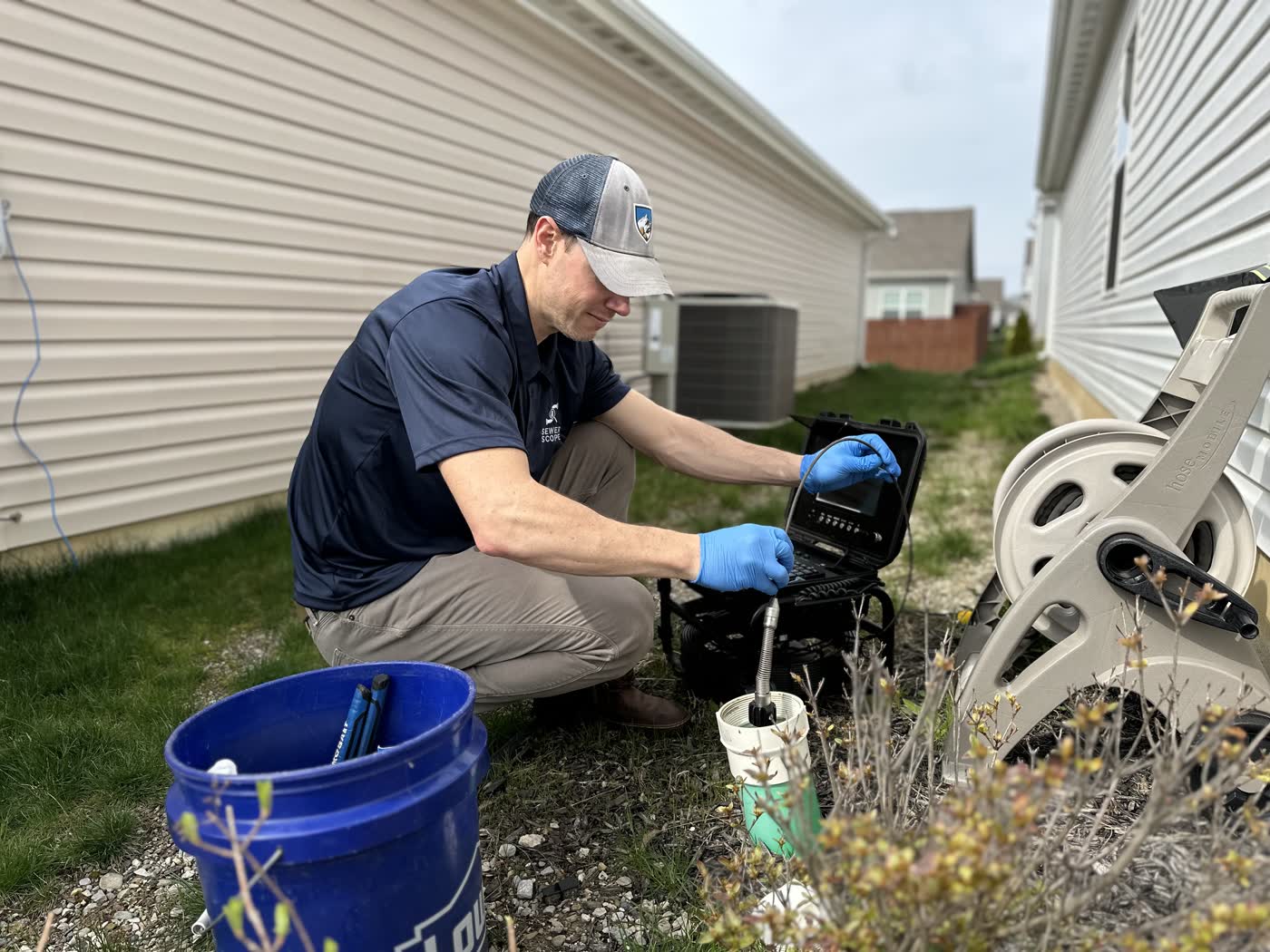
Hendricks County inspections run on the same platform as every other Sewer Scope job. Booking by phone at (317) 210-0084 or online. Same-week appointment standard. For city-sewer properties (Brownsburg, Avon, Plainfield town cores) the camera runs from cleanout to city tap. For septic properties (most outer-township Hendricks County addresses) the camera runs from cleanout to tank inlet, with inlet condition photographed. The report packages full HD video plus video capture plus a 1-page summary into a single shareable PDF and video link.
Turnaround is roughly 24 hours. Sewer Scope does not perform septic system inspections directly. We refer buyers to IDOH-approved septic inspectors for the full system evaluation when needed.
Hendricks County is dominated by 21st-century construction with PVC laterals in early mid-life. The defect-find rate is lower than older areas, but it is not low: even newer homes fail a sewer scope about 40% of the time. A scope is cheap insurance that documents the lateral condition for the buyer's records and catches the rare but expensive PVC joint separation or early-life root intrusion. For any Hendricks County home built before 2000, a scope is recommended. For homes in the older Plainfield town center or Danville historic square, it is essentially mandatory due diligence given the clay-tile lateral age and one-or-more replacement cycles in the 1945-1972 Orangeburg window.
Source: Sewer Scope Indianapolis camera log · U.S. Census Hendricks County QuickFactsHendricks County has the highest septic concentration of the three Indianapolis-metro counties. Outer townships (Liberty, Eel River, Marion, Center, Brown) include many rural and semi-rural properties on private septic systems administered by the Hendricks County Regional Health Department. Brownsburg, Avon, and Plainfield town cores are on municipal sewer. The boundary varies by subdivision and original build year. Always confirm at the specific property address before booking the inspection type.
Source: Hendricks County Health DepartmentHendricks County soils are mixed. The eastern portion shares Crosby silt loam and Brookston silty clay loam with Marion County. The western and central portion of the county includes more Miami silt loam and sandy outwash soils along the White Lick Creek and Mill Creek drainage. The sandier mix drains better than heavy Marion County clay, which reduces belly formation in older laterals. The trade-off: root systems can push deeper in sandier soil and find lateral joints from below as well as from the sides.
Source: USDA NRCS Web Soil SurveyThe Hendricks County Regional Health Department administers on-site septic system permits, inspections, and compliance. Indiana State Department of Health rules apply statewide. A sewer scope camera can document the inlet condition of a septic tank, but the full septic inspection (tank pumping, drain field assessment, soil percolation testing) is a separate scope of work performed by an IDOH-approved on-site sewage system inspector. Sewer Scope does not perform septic system inspections.
Source: Indiana State Department of Health On-Site Sewage Systems ProgramFHA does require a septic system inspection by an approved professional on homes connected to private septic rather than city sewer. The FHA appraiser flags visible signs of failure. The actual septic inspection is a separate add-on. FHA minimum distance requirements apply between well, septic, and property lines. In Hendricks County's septic-heavy outer townships, this is a meaningful line item that buyers and lenders need to plan around. Full details in our Indiana FHA + lender overlays guide.
Source: FHA.com on septic and well requirementsYes. The Plainfield town center along Main Street and Center Street holds the oldest residential stock in the county outside Danville. Original homes date from the 1880s through the 1920s, with clay-tile laterals, much of it replaced once. Some replacement work in the 1945 to 1972 era was Orangeburg. The outer Plainfield subdivisions (off Stafford Road, Vestal Road, along the Indianapolis Executive Airport corridor) are newer construction with PVC laterals and a low defect-find rate.
Source: Sewer Scope Indianapolis camera log · Town of PlainfieldHendricks County is one of the most reliable scope-volume markets in the metro for MIBOR agents (per MIBOR Realtor Association) because most buyer reps add a scope on every contract as cheap insurance regardless of age. The septic-versus-city-sewer question makes the conversation more nuanced than Hamilton County. The Realtor Partner Program covers the pre-sale scope add-on and pay-after-inspection billing.
The dense pre-1980 Indianapolis housing stock east of Hendricks. Highest defect-rate county in the metro.
Carmel, Fishers, Noblesville, Westfield. Comparable PVC-era profile, lower septic concentration.
Boone County town immediately north of Hendricks. Brick-paved historic Main Street with clay-tile laterals.