
Zionsville is a Boone County town inside the Indianapolis metropolitan area, defined by its brick-paved Main Street and a tightly preserved historic village that traces back to the 1850s. The brick paving and the 1880s residential blocks running outward from it sit over the oldest utility infrastructure in the Indy metro outside Marion County's urban core. Original laterals in the Brick Street Village are vitrified clay tile, much of it replaced once during the postwar Orangeburg window. Newer Zionsville subdivisions on the outer ring (Brookwood, Stonegate, Stonebridge) sit on PVC. Town of Zionsville Utilities operates the main and sets the lateral ownership boundary. A scope is the only practical way to learn what runs under the brick before the deal closes.
Zionsville is the largest town in Boone County, Indiana. The town and surrounding township are part of the Indianapolis-Carmel-Anderson metropolitan statistical area. The 2020 census put the Zionsville town population at 30,693, up from 14,160 in 2010 (per the U.S. Census Bureau QuickFacts for Zionsville). The growth more than doubled the town in a decade, almost entirely through outer subdivision development. The historic village center has stayed roughly fixed in footprint since the 1920s.
The Brick Street Village is the heart of Zionsville. Main Street is paved with red brick from West Sycamore Street north to West Pine Street, a stretch of about six blocks lined with 1880s-1920s residential and commercial buildings. The brick paving was original early-20th-century work, preserved deliberately by the town as a defining historic feature. Underneath the brick runs the original Zionsville utility infrastructure: water mains, sewer mains, electric, and gas, much of it now 100+ years old at the city-side and 60-80 years old at the most recent rehab. Lateral repair work in the Brick Street Village is materially more expensive than comparable work in newer subdivisions because the contractor must coordinate with the Town of Zionsville on brick removal, careful storage, replacement compaction, and brick reinstatement.
The residential blocks immediately surrounding the Brick Street Village (Cedar Street, Walnut Street, 1st Street, Maple Street, the older lots off Oak Street and Hawthorne Street) host the original Zionsville housing stock built 1880-1920. Original laterals are vitrified clay tile in short mortared sections. First-generation cast iron stacks run inside the foundations. Many laterals have been replaced once already, most often during the 1945 to 1972 Orangeburg window, which means the "replacement" is itself now well past 50-year useful life. Defect-find rates here approach or exceed Marion County's bungalow-belt rates on a per-property basis, partly because the housing stock is older and partly because the Town of Zionsville's deliberate preservation of historic homes has limited the volume of teardown-rebuild work that would have refreshed the underground infrastructure incidentally.
The outer Zionsville subdivisions began with mid-century postwar work along South Main Street and West Sycamore Road, then expanded heavily during the 1990s and 2000s. Subdivisions like Brookwood, Wolf Run, Stonegate, Stonebridge, Royal Run, and the various Boone County estate developments north and west of the historic core were built primarily 1995 through 2015 with PVC laterals throughout. Defect-find rates in these newer subdivisions are lower than the older core and approach the wider Hamilton or northern Boone County rate, but they are not low: even newer homes fail a sewer scope about 40% of the time, so a scope is still worth it. Outer lots can be large (one to ten acres) with correspondingly longer lateral runs.
Town of Zionsville Utilities (per the Town of Zionsville) operates the municipal sewer system. Connection fees and permit requirements differ from Marion County, Carmel Utilities, or Citizens Energy Group patterns. The Boone County Health Department administers private septic systems in the outer Boone County properties around Zionsville that remain on septic rather than municipal sewer. Always confirm jurisdiction at the specific address.
Soil under Zionsville is mapped predominantly Crosby silt loam with Brookston silty clay loam in the lower areas along Eagle Creek and its tributaries, per USDA NRCS mapping. Behavior is similar to the rest of the Indy metro. The Boone County Soil and Water Conservation District publishes detailed soil and land-use references useful for property-level due diligence.
The tree canopy in the Brick Street Village and the surrounding historic residential blocks is dominated by mature white oak, bur oak, pin oak, and silver maple, with some specimen oaks dating to the original 1880s-1900s plantings (per Indiana DNR Community Urban Forestry). Mature oak root systems are particularly aggressive on older laterals because oak taproots can intrude on a lateral from below as well as from the sides. The newer Zionsville subdivisions have younger, planned mixed canopies with correspondingly less root-intrusion pressure on lateral runs.
1. Vitrified clay tile lateral failure in the Brick Street Village and historic residential blocks (peak prevalence: anywhere within 5 blocks of Main Street paved brick, 1880-1920 builds). Original Zionsville historic-village laterals are vitrified clay tile in short 2 to 4 foot sections with mortared joints. The clay pipe body can last 100 to 150 years but the mortared joints fail much sooner. Joint separation, root intrusion at joints, partial collapse, and offset shifts are common. On camera: visible stepping at joints, dense root masses through the joints, or pinched sections where ground pressure has deformed the pipe shape. Repair costs are elevated in the historic district because of the brick-paving coordination: full lateral replacement runs $4,000 to $15,000 versus a typical Hamilton County $1,500 to $5,000 range, per Patriot Dirt's Indianapolis cost data plus the brick reinstatement premium. Trenchless lining ($1,500 to $4,000) is generally preferred when the lateral grade permits.
2. Orangeburg "replacement" lateral failure (peak prevalence: same historic blocks, postwar replacement work 1945-1972). The classic Zionsville scope discovery is the property where the 1890s clay tile lateral was replaced once, in the 1950s or 1960s, with Orangeburg pipe that is now itself well past 50-year useful life. Orangeburg useful life is approximately 50 years per Wikipedia's Orangeburg reference, and these replacement-era installs are now 60 to 75 years old. On camera: corrugated dark brown to black walls, often deformed to oval, sometimes partially collapsed. Repair is full replacement, with brick-paving premium for any historic-district run. A pre-purchase scope is the only practical way to surface this layer before closing.
3. Mature oak root intrusion (peak prevalence: historic village and 1900-1940 residential lots with specimen oaks). The Zionsville historic village's mature oak canopy is older and arguably more aggressive on laterals than Marion County's silver-maple monoculture. White oak and bur oak taproots can find joints from below at depths that maple root systems do not typically reach. Root intrusion accounts for more than 50 percent of sewer blockages nationally per ARS Rescue Rooter, and Zionsville's historic-village rate is at the high end of the metro distribution. On camera in mature-oak Zionsville lots: rope-thick root masses at joints, sometimes with taproot intrusion entering from the pipe bottom. Repair runs $1,500 to $5,000 for spot clearing, $1,500 to $3,500 for trenchless lining (per Carter's My Plumber Indianapolis).
4. PVC joint separation in 1995-2010 outer Zionsville subdivisions. The Brookwood, Stonegate, Stonebridge, and Wolf Run subdivision builds are now 15 to 30 years old. PVC pipe at the body level has a 50+ year useful life under proper installation per Uni-Bell PVC Pipe Association, but the failure mode is the joint. Boone County's freeze-thaw soil movement gradually pulls PVC joints apart over a 20 to 30 year window. The gap is usually a quarter inch or less but enough for moisture-seeking maple or oak roots to find. Repair is trenchless lining ($100 to $600) or spot excavation ($1,500 to $3,500). The ASCE Infrastructure Report Card identifies root intrusion as a leading wastewater infrastructure failure mode (per ASCE Infrastructure Report Card).
One additional Zionsville note: the outer Boone County estate properties around Zionsville (the larger acreage developments north and west of the historic core) have a meaningful share of private septic systems administered by the Boone County Health Department. Indiana State Department of Health on-site sewage rules apply (per IDOH On-Site Sewage Systems Program). A scope on a septic property terminates at the tank inlet with inlet condition photographed.
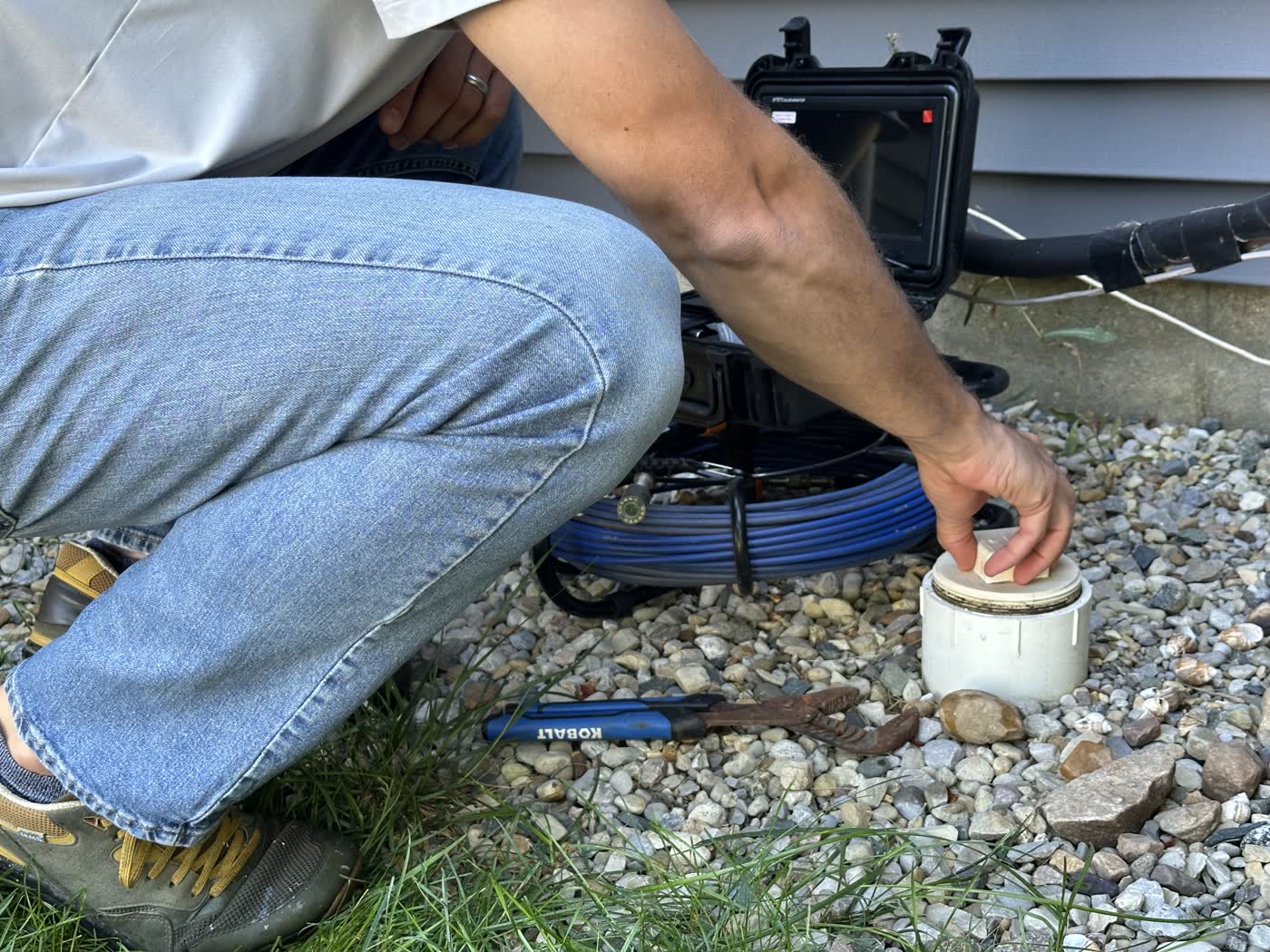
Zionsville inspections run on the same platform as every other Sewer Scope job. Booking by phone at (317) 210-0084 or online. Same-week appointment standard. For city-sewer properties on Town of Zionsville Utilities, the camera runs from cleanout to the city tap. For outer Boone County estate-property septic holdouts, the camera runs from cleanout to tank inlet with inlet condition photographed. Sewer Scope does not perform septic system inspections directly. We refer buyers to IDOH-approved septic inspectors for the full system evaluation when the property is on septic.
Reports flag historic-district context where applicable: any Brick Street Village or pre-1940 lateral run is documented with a note that repair work will carry the brick-paving coordination premium. report turnaround is roughly 24 hours. The report and shareable video go directly to you, the customer, so you can pass them along to your agent, lender, plumber, or anyone else, exactly as you see fit.
Yes. Zionsville is the largest town in Boone County, Indiana, although it sits in the Indianapolis metropolitan statistical area and most of its residents commute into the broader Indianapolis economy. Zionsville's location west of Carmel and north of Indianapolis means it shares the metro housing market with Hamilton and Marion counties but operates under Boone County government and Town of Zionsville Utilities.
Source: U.S. Census Zionsville QuickFactsYes. The Brick Street Village (Main Street and the surrounding historic district) holds the oldest residential and commercial stock in town. Original construction dates from the 1880s through the 1920s. Original laterals are vitrified clay tile, with first-generation cast iron stacks. Many have been replaced once already, often during the 1945 to 1972 Orangeburg window. Defect-find rate in the Brick Street Village is among the highest in the Indianapolis metro on a per-property basis.
Source: Sewer Scope Indianapolis camera logThe Town of Zionsville operates the municipal sewer system through Zionsville Utilities. Connection fees, permit requirements, and the lateral-vs-main ownership boundary differ from Marion County or Carmel patterns. Some outer Boone County properties around Zionsville are still on private septic systems administered by the Boone County Health Department. Always confirm jurisdiction at the specific address.
Source: Town of ZionsvilleZionsville's Main Street was originally paved with brick in the early 20th century. The town has preserved the brick paving as a defining historic feature of the village. The brick sits over the original 1880s-1920s utility infrastructure, which means lateral repair work in the historic district requires the contractor to coordinate with the Town of Zionsville on brick removal, restoration, and traffic management. Repair costs in the historic district can run materially higher than comparable work in newer subdivisions.
Source: Town of Zionsville historic district guidanceThe Zionsville historic village features mature oak (white oak, bur oak, pin oak) planted between the 1880s and 1930s, with some silver maple and sugar maple as well. Mature oak root systems run deep and produce taproot intrusions that find old clay-tile and Orangeburg joints from below as well as from the sides. Newer outer Zionsville subdivisions have planned tree mixes with less single-species root pressure on lateral runs.
Source: Indiana DNR Community Urban ForestryMost outer Zionsville subdivisions built since 1995 use PVC laterals throughout and have a low defect-find rate. The scope is still useful as cheap insurance and to document the lateral condition for the buyer's records. Outer Zionsville lots can also have longer lateral runs than typical inner-town addresses because of larger lot sizes. The same 24-hour report turnaround applies.
Source: Sewer Scope Indianapolis on-site measurement logZionsville is one of the highest-priced markets in the metro and one of the most scope-aware buyer pools (per MIBOR Realtor Association). Historic village listings carry meaningful lateral risk and pre-purchase scope is increasingly standard due diligence. Pre-sale scope on a Brick Street Village listing pairs with a documented report that addresses the hidden-defect objection on day one. The Realtor Partner Program covers the pre-sale scope add-on and pay-after-inspection billing.
Zionsville's eastern peer city in Hamilton County. Old Town Carmel historic district plus Village of WestClay PVC.
The full county profile just east. Newer construction dominant with select older pockets.
Indianapolis to the south. The dense pre-1980 bungalow belts that anchor the metro defect catalog.
Adjacent to the south. 21st-century build profile plus historic Plainfield and Danville pockets.