
Noblesville is the Hamilton County seat and the metro's most historically intact small city. The downtown square (Logan Street, 8th Street, Conner Street, the residential blocks running outward from the Hamilton County Courthouse) is the oldest part of the county, with houses dating to the 1880s. Original laterals around the square are vitrified clay tile, some replaced once during the postwar Orangeburg window. Morse Reservoir perimeter homes built since 1960 sit on a mix of older lake-cottage clay tile and newer PVC. The Promise Road and 146th Street corridor subdivisions built since 2000 sit on PVC throughout. A scope clarifies which group a Noblesville property belongs to. Noblesville Utilities owns the main and sets the lateral ownership boundary.
Noblesville is the Hamilton County seat and the third-largest city in the county after Carmel and Fishers. The 2020 census put the population at 69,604, up from 51,969 in 2010 (per the U.S. Census Bureau QuickFacts for Noblesville). The growth has been concentrated in the outer subdivisions: Promise Road, Olio Road, the 146th Street corridor, and the Morse Reservoir perimeter. The historic downtown core has remained intact through the growth, which is unusual for the metro.
The Hamilton County Courthouse anchors the downtown square at the intersection of 8th and Logan, originally constructed in 1879 (per Indiana Historical Society). The surrounding residential blocks were platted in the 1840s through the 1870s and the housing stock running outward from the courthouse square is dominated by 1880s through 1920s single-family homes. Streets like Maple Avenue, Cherry Street, North 10th, North 11th, and Conner Street feature Victorian-era homes with original vitrified clay tile laterals plus first-generation cast iron stacks. Many laterals have been replaced once, often during the 1945 to 1972 Orangeburg window, which means the "replacement" is itself now well past 50-year useful life. The defect-find rate around the historic square approaches Marion County bungalow-belt rates and exceeds the rest of Hamilton County by a wide margin.
Morse Reservoir was created in 1956 by impounding Cicero Creek for water supply, and the lake-perimeter development ran in waves through the 1960s, 1970s, and again through the 1990s and 2000s. The older Morse-perimeter lake cottages (mostly off East 191st Street, North 19th Street, the Morse Reservoir north shore) carry the same mid-century vitrified clay tile or first-generation cast iron laterals you would find in the Geist Reservoir 1960s pockets in Fishers. Some Morse homes remain on private septic systems administered by the Hamilton County Health Department. The newer Morse-perimeter subdivisions built since the 1990s use PVC laterals throughout.
The Promise Road corridor running east from State Road 37 toward the Hamilton County line is the city's newest housing layer. Subdivisions like Bridgewater (note: different from Carmel's Bridgewater Club), Lochaven, the Reserve at Lockerbie, and the various Olio Road developments were built primarily 1998 through 2015 with PVC laterals throughout. The 146th Street corridor running west toward Cicero and Westfield has a similar profile. Defect-find rates in these newer subdivisions are lower than the older core and approach the wider Hamilton County rate, but they are not low: even newer homes fail a sewer scope about 40% of the time, so a scope is still worth it.
Noblesville Utilities (per the City of Noblesville) operates the municipal sewer system. Unlike Carmel (Carmel Utilities) or Fishers (Citizens Energy Group), Noblesville's utility is a separate department with its own connection fee schedule and permit requirements. The lateral-vs-main ownership boundary tracks the property line in most subdivisions. Confirm jurisdiction at the specific address before any repair quote.
Soil under Noblesville is a mix of Crosby silt loam in the southern half of the city, Brookston silty clay loam in the low areas along Cicero Creek and Stony Creek, and Miami silt loam on the rolling terrain north of the city toward Cicero, per USDA NRCS mapping. The freeze-thaw behavior is similar to the rest of Hamilton County. The older downtown grid's mature trees and 145-year-old lot disturbance history make it the highest-belly-formation zone in the city.
The tree canopy in the downtown square is dominated by mature silver maple, sugar maple, and pin oak planted between the 1880s and 1940s. The Indiana DNR's urban forestry references catalog the regional canopy (per Indiana DNR Community Urban Forestry) and the Noblesville historic district scores in the top tier for root-intrusion findings in our Hamilton County camera log.
1. Vitrified clay tile lateral failure in the downtown grid (peak prevalence: blocks within 4 blocks of the Hamilton County Courthouse, 1880s-1920s builds). Original Noblesville downtown laterals are vitrified clay tile (VCP) in short 2 to 4 foot sections with mortared joints. The clay pipe body can last 100 to 150 years but the mortared joints fail much sooner. Joint separation, root intrusion at joints, partial collapse, and offset shifts are all common. On camera: visible stepping at joints, rope-thick root intrusion through the joints, or a pinched section where ground pressure has deformed the pipe. Repair runs from spot trenchless lining at $1,500 to $3,500 to full lateral replacement at $4,000 to $15,000 depending on length and depth, per Patriot Dirt's Indianapolis cost data.
2. Orangeburg "replacement" lateral failure (peak prevalence: same downtown blocks, where postwar replacement work in the 1945-1972 window used Orangeburg). The painful version of the Noblesville scope is the property where the original 1890s clay tile lateral was already replaced once, in the 1950s or 1960s, with what the homeowner of the era thought was a modern upgrade: Orangeburg pipe. That "modern" pipe is now 60 to 75 years old and well past 50-year useful life. Useful life of Orangeburg is approximately 50 years per Wikipedia's Orangeburg reference. On camera: corrugated dark brown to black walls, often deformed to an oval or partial collapse. Repair is full replacement at $4,000 to $15,000. A scope is the only practical way to discover the replacement-era Orangeburg layer before closing.
3. Root intrusion from mature silver maple and oak (peak prevalence: downtown grid 4-block radius from courthouse, plus older Morse perimeter lots). The mature silver maple and pin oak canopy in downtown Noblesville produces aggressive moisture-seeking root systems that find every joint and crack in older laterals. Root intrusion accounts for more than 50 percent of sewer blockages nationally per ARS Rescue Rooter's reference. On camera in downtown Noblesville: dense root masses filling 30 to 80 percent of pipe diameter in clay-tile and Orangeburg joints. Repair runs $1,500 to $4,000 for spot clearing, $1,500 to $3,500 for trenchless lining of recurring intrusion zones (per Carter's My Plumber Indianapolis).
4. PVC joint movement in Promise Road and 146th Street corridor 1998-2010 builds. The outer Noblesville subdivisions are the youngest layer of housing in the city, and the PVC laterals here are now 15 to 30 years old. As in Carmel and Fishers, the failure mode is joint separation from freeze-thaw soil movement, not pipe-body failure. Hairline root intrusion at joints. Small offsets at joints. Repair is trenchless lining ($1,500 to $4,000) or spot excavation ($1,500 to $3,500). Uni-Bell PVC Pipe Association catalogs installation-defect patterns (per Uni-Bell PVC Pipe Association) and the ASCE Infrastructure Report Card tracks root intrusion broadly (per ASCE Infrastructure Report Card).
One Noblesville-specific concern: the original Noblesville sewer infrastructure dates to the early 20th century in the downtown core, and Noblesville Utilities has been incrementally upgrading mains as the city has grown. Some downtown blocks have newer city mains running adjacent to older laterals. The city-tap connection itself can sometimes be the failure point rather than the homeowner's lateral. A scope to the tap clarifies where the boundary is.
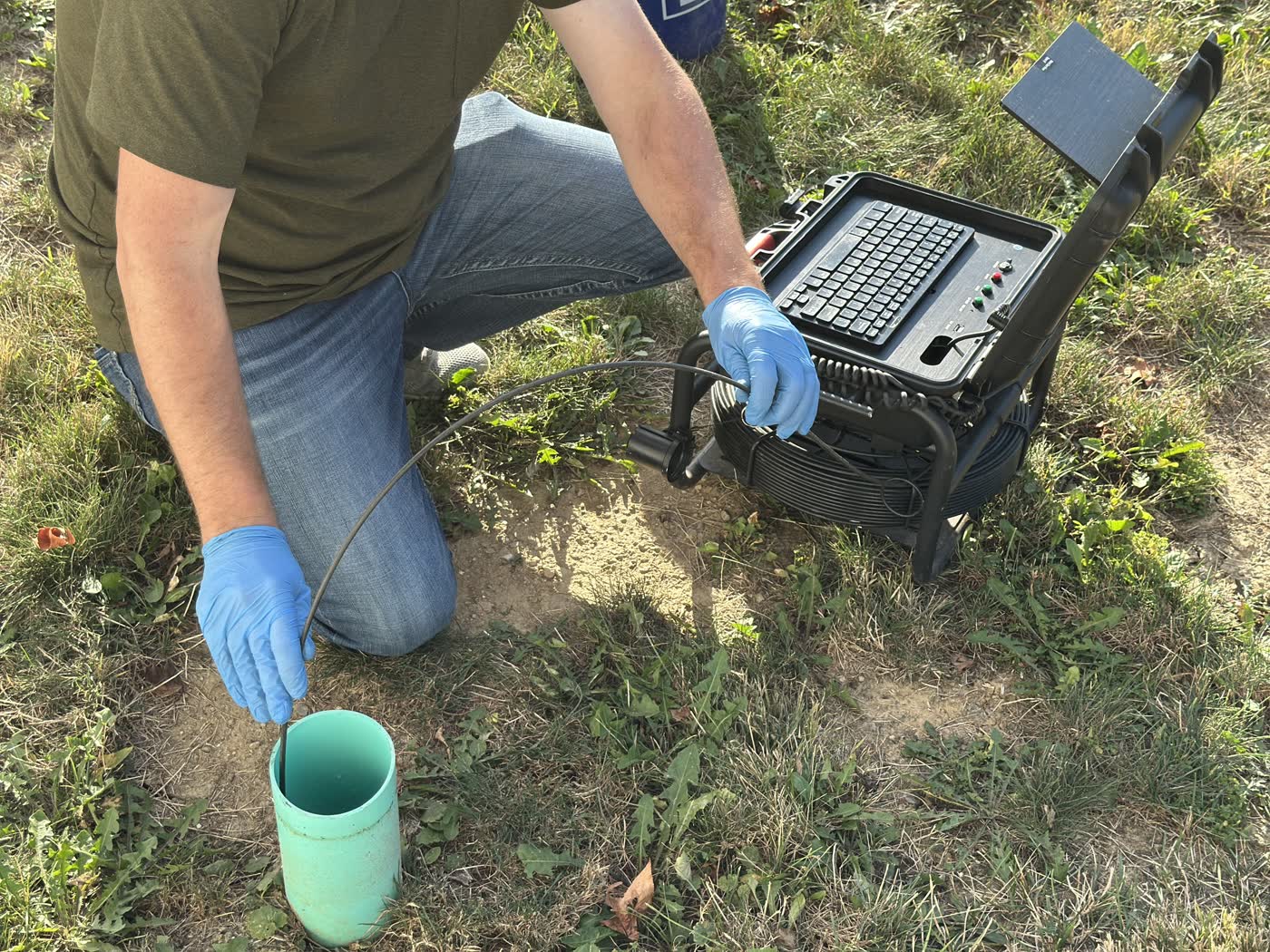
Noblesville inspections run on the same platform as every other Sewer Scope job. Booking by phone at (317) 210-0084 or online. Same-week appointment standard. For city-sewer properties on Noblesville Utilities, the camera runs from cleanout to the city tap. For Morse Reservoir septic holdouts, the camera runs from cleanout to tank inlet with inlet condition photographed. Sewer Scope does not perform septic system inspections directly. We refer buyers to IDOH-approved septic inspectors for the full system evaluation when the property is on septic (per IDOH On-Site Sewage Systems Program).
report turnaround is roughly 24 hours. The report and shareable video go directly to you, the customer, so you can pass them along to your agent, lender, plumber, or anyone else, exactly as you see fit.
Yes. The Noblesville downtown square (Logan Street, 8th Street, Conner Street, around the Hamilton County Courthouse) holds the county's oldest residential stock, with original construction dating from the 1880s through the 1920s. Original laterals on these blocks are vitrified clay tile. Many have been replaced once already, often during the 1945 to 1972 Orangeburg window. Defect-find rate around the downtown square is among the highest in Hamilton County.
Source: Sewer Scope Indianapolis camera log · Indiana Historical SocietyMorse Reservoir was created in 1956 and the lake-perimeter development ran 1960s through 2000s. Some older lake-cottage holdouts remain on private septic systems administered by the Hamilton County Health Department. Most modern Morse perimeter homes are connected to Noblesville Utilities municipal sewer. The boundary varies by subdivision and original build year. Always confirm at the specific address before booking the inspection type.
Source: IDOH On-Site Sewage Systems ProgramNoblesville Utilities operates the City of Noblesville sewer system as a municipal utility. Connection fees, permit requirements, and the lateral-vs-main ownership boundary differ from the Carmel Utilities or Citizens Energy Group patterns. Confirm at the specific address before any repair quote.
Source: City of NoblesvilleThe original 1880s-1920s downtown Noblesville laterals are vitrified clay tile in short 2 to 4 foot sections with mortared joints. Cast iron stacks inside the foundation are from the same era. Many original laterals were replaced once between 1945 and 1972 with Orangeburg pipe, which is itself now well past 50-year useful life. A scope clarifies whether the lateral is original clay tile, replaced Orangeburg, replaced cast iron, or a later modern PVC replacement.
Source: Wikipedia Orangeburg reference · Structure Tech field guideThe Noblesville downtown square features mature silver maple, sugar maple, and pin oak planted between the 1880s and 1940s. Mature trees within 30 feet of a lateral are essentially guaranteed to cause root intrusion in pre-1980 clay-tile or Orangeburg laterals. The Promise Road corridor and Morse Reservoir perimeter have a mixed canopy including white oak and bur oak with deeper root systems that can intrude on older laterals from below.
Source: Indiana DNR Community Urban ForestryIncreasingly yes. MIBOR data and Sewer Scope Indianapolis order volume both show rising scope-order frequency for Noblesville pre-1980 listings, particularly anywhere inside the historic downtown grid. For newer Morse Reservoir, Promise Road, and outer subdivisions, scope orders are still discretionary but trending toward standard buyer due diligence.
Source: MIBOR Realtor Association · Sewer Scope Indianapolis order logNoblesville is the Hamilton County market where the scope conversation looks the most like Marion County's. Downtown listings in the 1880s-1920s grid carry meaningful lateral risk and a pre-purchase scope is increasingly standard due diligence (per MIBOR Realtor Association). About 80% of our inspections turn up some deferred maintenance on the sewer line, so a pre-sale scope on a historic downtown listing gives the seller a real advantage in negotiations and helps the buyer avoid any unwanted (and sinky) surprises after closing. Realtor Partner Program covers the pre-sale scope add-on and pay-after-inspection billing.
Full county profile. Noblesville is one of four major cities.
Hamilton County's southwest peer. Old Town Carmel plus Village of WestClay.
Noblesville's southern neighbor. Nickel Plate District plus 1990s subs plus Geist perimeter.
Indianapolis to the south. The dense pre-1980 bungalow belts the metro defect catalog is built around.